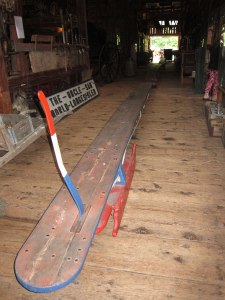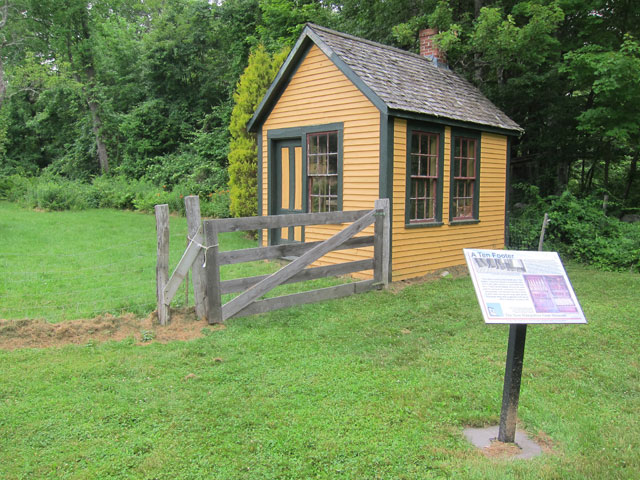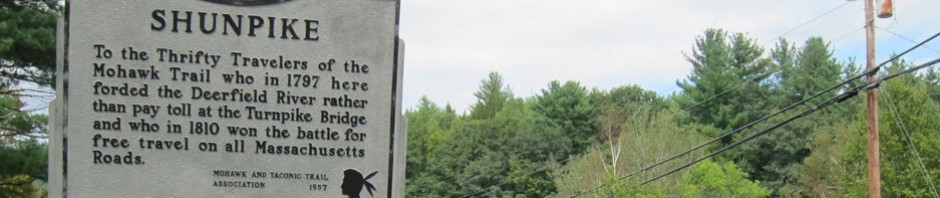
TWO LOCAL THINGS YOU NEED TO DO – NOW !!! — 3 and 4 October 2016

This is not the conclusion of “Everything Dutch in the Hudson Valley” – I know that. But this will be a brief encouragement for some nearby explorations you need to do very soon. Scott and Betty arrived with their Airstream on Monday afternoon on their way to Maine. We planned a full day of play and exploration on Tuesday before they left today, Wednesday. Shortly after arrival on Monday Betty said, “I need to accomplish some sight seeing today in NH.”  Well, you see, they had to sleep in the Airstream even at my house, because they had not slept in it in NH, and now have just about done so in all states. Part of her “check-off” is to actually play tourist. Her desire – visit the old Steamtown yards since they live just about one hour south of Steamtown’s new Scranton home. The yards here are now the home of the Green Mountain Railroad.

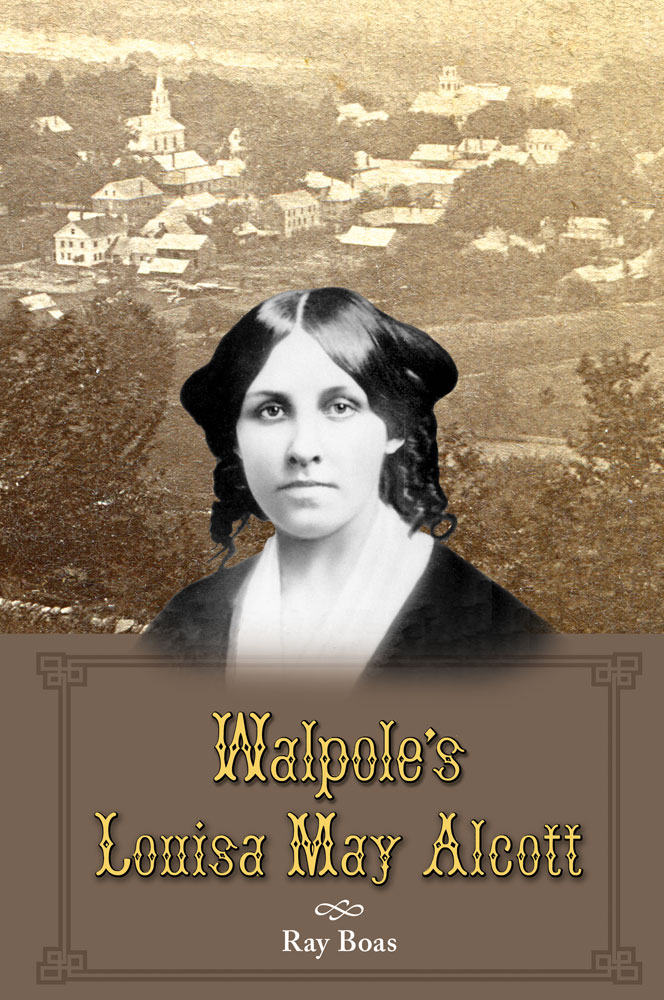
I believe I am going to become a professional tour guide. Having just completed my Horse Thieves lecture on “The Development of a Village;” and, my Saturday tour for Louisa May Alcott aficionados around Alcott associated spots in town, I was motivated, and animated to tour my dear friends, and impressed myself with the knowledge I was able to impart. But we have explored before together, and learning one thing leads to at least two more questions to answer (and those answers usually begat more questions). It does not end.

We explored the yard in North Walpole examining the round table and rolling stock. I explained were the tracks came from and went. We looked at the old stone bridge, and then I needed to also show them the old yard in Rockingham, north of Bellows Falls. But on the way, we toured the “island,” and its rail facilities, old factories, and the Indian Petroglyphs. Heading back to the Village Square I proclaimed, “I need to show you the railroad tunnel under the village.” So I turned left down the alleyway, which I had only walked down a few dozen feet before. There were the tracks, the tunnel to the left, and I continued down the road to:
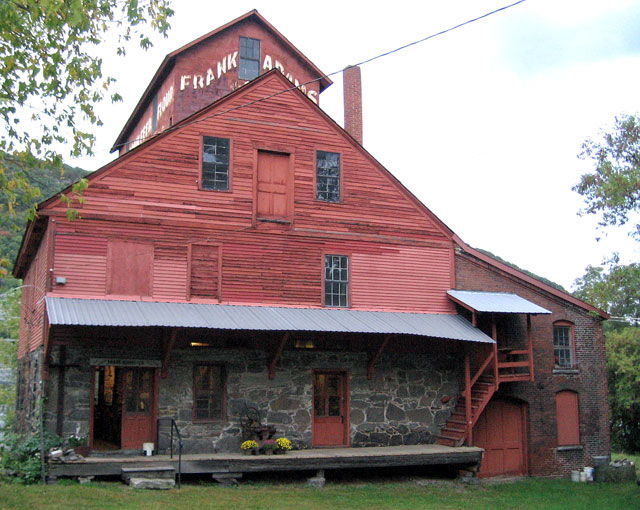
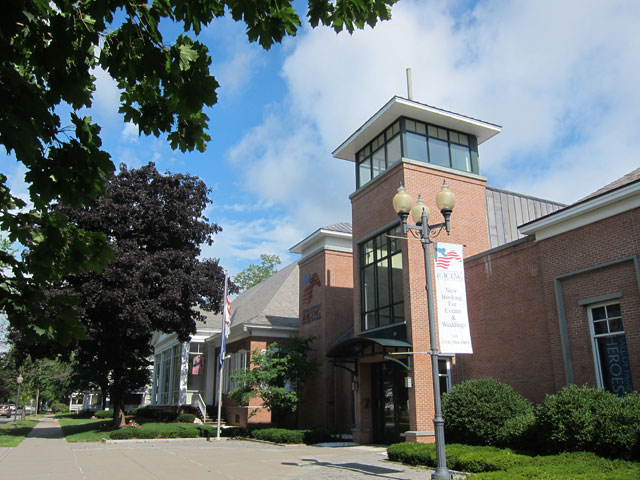
Bellows Falls Historical Society - Adams Grist Mill Museum

Bellows Falls Historical Society – Adams Grist Mill Museum

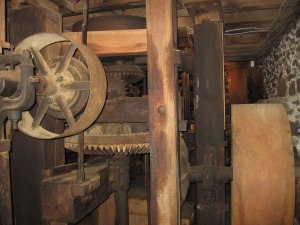
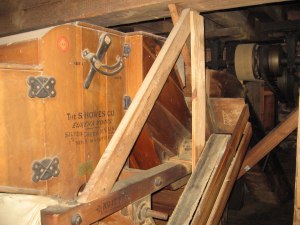
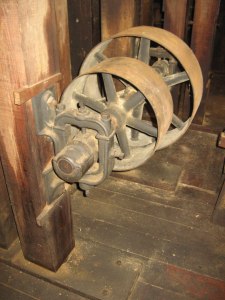
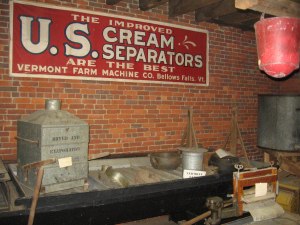
The door was open – on a Monday evening – we have done this before elsewhere, we just went in. “Bound to be someone inside I know,” I said, and yes, Chris said, “hi Ray, and welcome.”  My first visit ever, and to be repeated. Built in 1831, converted to electricity in the 1920s, and operated until 1961, the equipment is amazing, complete, and we all bet you could just turn the power back on and grind away. Here is a sample of the inside you have to explore:

Remember you can click on any image to open larger size images.
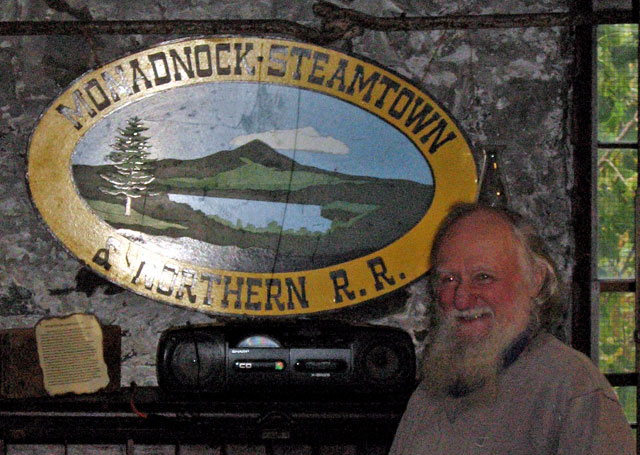
Chris before one of the original Steamtown signs

Chris before one of the original Steamtown signs

We departed, leaving a nice donation for the museum. I also asked Chris if we could meet sometime to develop an article for my Walpole Clarion readers, and we are going to do that.
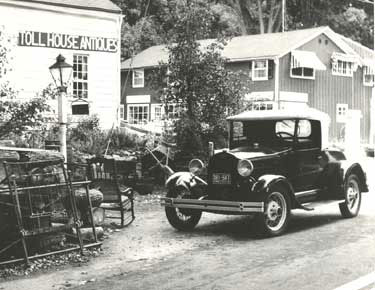
My 1929 Model A Ford Roadster

My 1929 Model A Ford Roadster

Tuesday, our plan was to head to Historic Deerfield in Massachusetts, less than an hour away. I first drove through Deerfield in the pouring rain in the summer of 1963 in Belzebuth, my 1929 Model A Ford Roadster. Since living here, I drive through many times a year stopping at the giftshop/book store, and to have lunch or dinner at Champney’s Restaurant & Tavern. BUT – for some reason I have never toured the homes and museum buildings. It was “meant to be” to share with Scott and Betty.
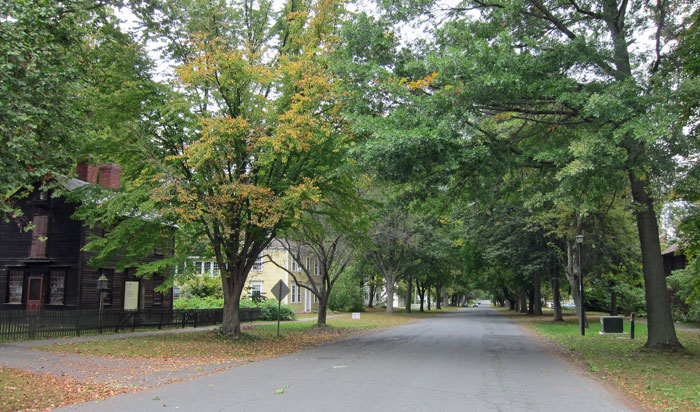
The view as you enter Old Main Street from the south. I always enter this way because I first did in 1963.
The view as you enter Old Main Street from the south. I always enter this way because I first did in 1963.

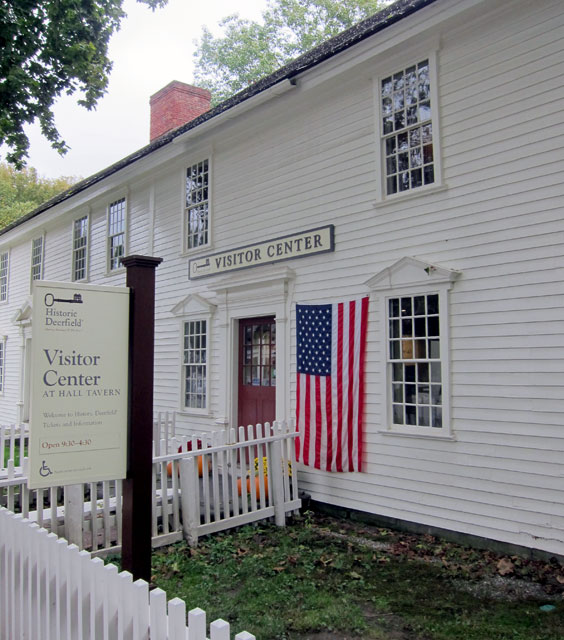
Historic Deerfield Visitor Center

Historic Deerfield Visitor Center


We bought our tickets at the Visitor Center — $14 – a tremendous bargain — and were given an introduction to the day’s events. Four homes were open for guided tours, and others for self-guided tours to see the homes or collections inside. Our timing was perfect to start with the Frary House at 11AM.
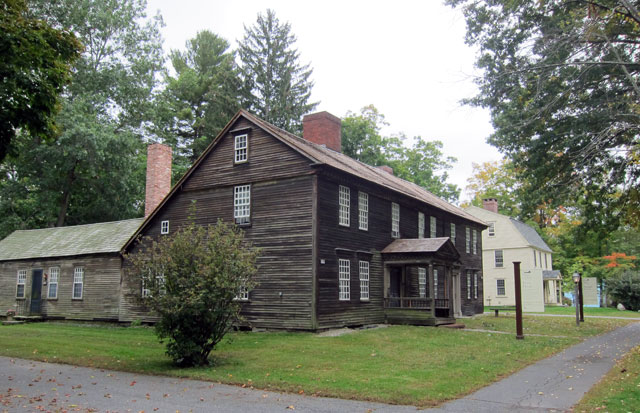
Frary House - Historic Deerfield

Frary House – Historic Deerfield

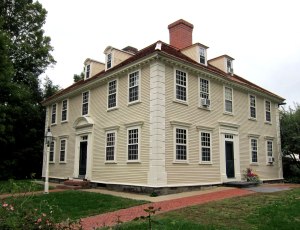
Built c1750, Miss C. Alice Baker began restoration in the 1890s in the Colonial Revival style. She was an early saver of the village, and was instrumental also in the Arts and Crafts movement with cottage industries that developed here making items for tourists, developing the tourist trade early on. The guided tours of this home and two of the three others were absolutely fantastic with exceptional well-informed docents. The tours are planned to last about 35 minutes, but we were fortunate. We spent 45-50 minutes here (with two other guests), but (more later on these) at the Ashley House and later at Wells Thorn House we spent over an hour – ending only because the next tour was to start. We were alone on those tours, and the paid docents could tell we were knowledge thirsty, and knowledgeable visitors.  It makes a difference, as Scott and Betty can attest having now served two stints as National Park Service volunteer guides. We headed north up Old Main Street to the Williams House for the noon tour. Docent not the best, we had 11 people total on the tour, but glad we at least saw the house. Finishing up, we crossed the street to the Ashley House for the 1PM tour.
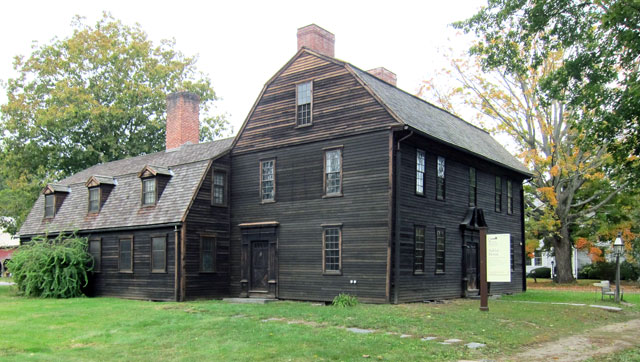
Ashley House - Historic Deerfield

Ashley House – Historic Deerfield

The docent met us outside and began visiting – it was only the 3 of us entranced and learning. He started with the geology and Native American background of the area. Old Deerfield is on a small extremely fertile plateau surrounded to the south, west and east by plains prone to flooding. Flooding resulting from the Deerfield River (to the west) which flows north from the west to empty into the Connecticut River in Greenfield. During freshets, the water flowing south down the Connecticut battles up against the water attempting to empty into it from the Deerfield River. The resulting flooding over millennium depositing exceptional soil and Native American settlements long before English settlers came in 1669. And, then there was the 1704 massacre and subsequent abandonments, but those are stories for you to find out on your own. For the next hour, we knew we were getting an exceptional insight into history, and answers to the questions we posed. And, always wondering why Old Deerfield was what I thought was a loop road off the newer US Route 5, I now know it was the fertile plateau and surrounding lowlands that cause the original road to curve in and out as it does.  I love learning why something is the way it is. Before I head to the last house, here is a gallery of images for you, and you can click any to get to the larger images.

At 3PM we arrived at the Wells Thorn House for a “walk through time.”
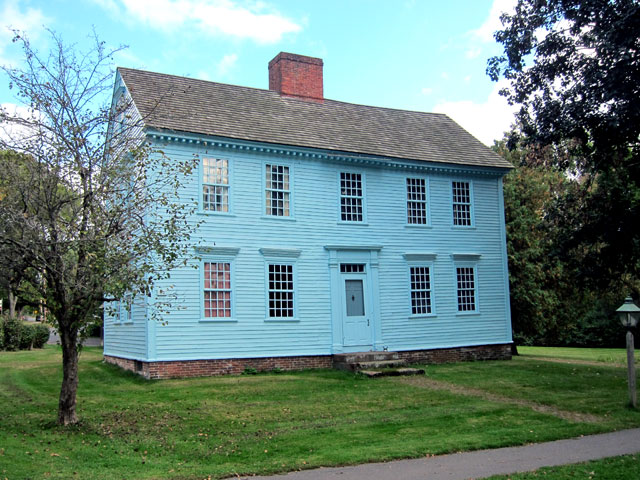
Wells-Thorn House at Historic Deerfield. Painted blue by the original owner, a lawyer, so everyone knew where he lived.

Wells-Thorn House at Historic Deerfield. Painted blue by the original owner, a lawyer, so everyone knew where he lived.

The rooms are set up to show a progression of furnishings from 1725 to the 1850s. Nicely done. At the conclusion, when chatting with our docent, he asked where we were from. For some reason, for the first time today, I mentioned the town too, and that opened up a whole new line of conversation. Ends up he plays in a band in front of my house each summer, and then he added, “I worked for the Green Mountain Railroad.”  Well, we bombarded him with questions left over from the previous day’s explorations. And we now have the answers.

But, at 4PM we were “housed out.” We had only gotten into one of the house exhibitions – the furniture. So, I have at least two more trips back to see everything else. We headed out, stopping in front of one more private house.
sb-21

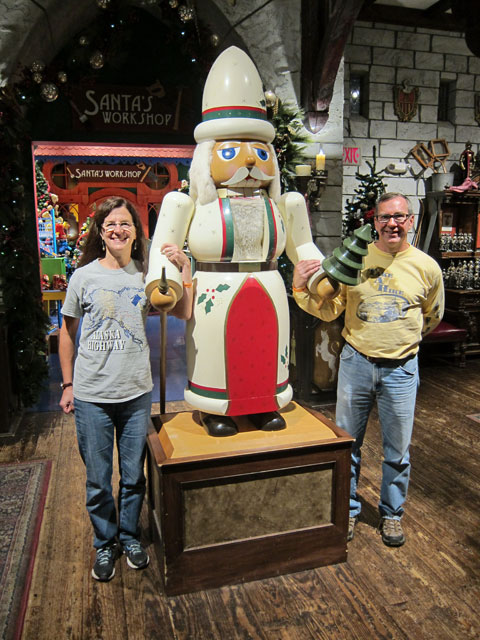
Scott, Betty, and friend at Yankee Candle

Scott, Betty, and friend at Yankee Candle


I suggested we head a tad south to Yankee Candle’s flagship store, and Betty said, “you have always told us we had to see that, let’s go.” Scott chimed in, “oh, no!”  It is always fun there, full of eye-candy, and worth a stop when there are no cars or buses out front. So, off we went.


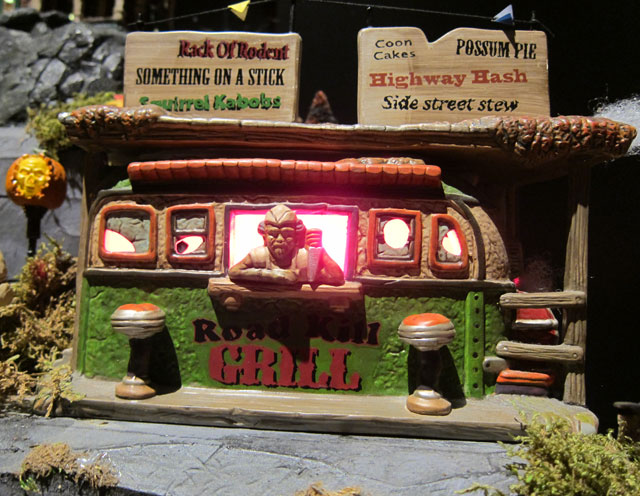
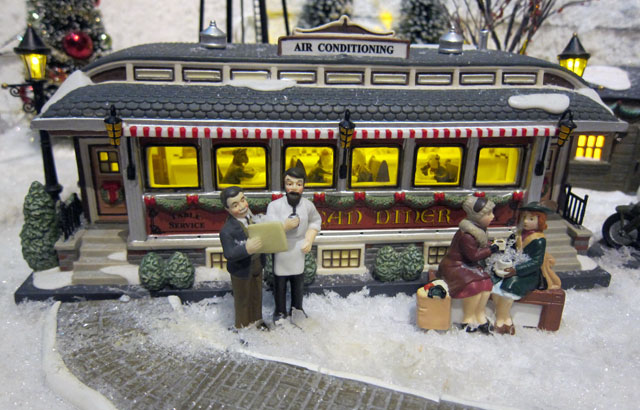
You never know what you are going to see, I told Betty to take her camera in. She did, and I did. You know I like diners, and here are two that were in the room of villages (click to enlarge).
sb-23

sb-24

It is always a magical place here.

sb-25

Betty just posted on their site all about our adventures together. Great images (which I did not include) of our visit to the Green Mountain Railroad — so, please visit what Betty just posted (about 10:10 PM Wednesday) — click on the on the link that follows — https://scotttho.wordpress.com/2016/10/05/its-fall/

RAY RECOMMENDS:

1 – Plan a number of visits to Historic Deerfield in Old Deerfield, Massachusetts

2 – Plan to visit and experience the Adams Grist Mill in Bellows Falls, VT

ETYMOLOGY — LEXICOLOGY — PHRASEOLOGY

A new addition (as long as I remember) of some of the fascinating things I learn

1 – MIND YOUR P’s AND Q’s — shouted out in a colonial tavern by the barkeep to patrons meaning “Mind your pints and quarts.” Time to come fill up for a final round.

2 – ROOM AND BOARD — In colonial homes/taverns, with your room for the night you could also get fed. With limited furniture a board could would be brought out, placed upon trestle or “saw horses” to serve as a table for your meal.
Posted in Day (or maybe two) Trips, ROADS and ROUTES | Tagged , , , , , , , | 4 Comments

18 SEPT 2016 HEADING TO — EVERYTHING DUTCH IN THE HUDSON VALLEY — AND BACK FROM 23 SEPT 2016

Welcome back to SHUNPIKING WITH RAY. I seem to find it harder and harder to find the time to document my explorations for you, and those documentations are coming later after a journey. I thought of a good way, however, to split up my recent Road Scholar program – Discover Everything Dutch in the Hudson Valley. First I am going to tell you what I did on the way to the conference center in Warwick, New York, followed by my journey home. In my next post (hopefully soon) I will give you some of what I learned about the neglected history of the 17th century Dutch in the Hudson River Valley, and encourage you to learn about it also.

First, I highly recommend you get a copy of Russell Shorto’s book, THE ISLAND AT THE CENTRE OF THE WORLD. Recommended reading for the program I attended, it is amazing, and highly readable giving you a wonderful flavor for the Dutch presence from 1609 in the Hudson River until the British took over in 1674. You will not be disappointed, and please first read the Epilogue to learn how all this history has been compiled in spite of what has been lost. Remember too that “the victor writes the history,” thus we all have learned little from prior to British rule. But more on that in my next post.

Sunday, September 18, I crossed Vermont on Route 9. In the mountains, the leaves were changing already – reds and oranges glistening in the rain. Picking up the NY State Thruway, I exited at Kingston. My plan was to start in Hurley, NY, which I told you about in July when I came back from Scott and Betty’s at the end of the post. I was not sure if during our visit to Hurley during the program whether a visit to the museum would be included (ends up it was).  I stopped in Hurley, and a festival was going on in town, and outside the museum.

Hurley, NY, Historical Museum at festival time.

Hurley, NY, Historical Museum at festival time.

On my way to my main exploration for the day, I stopped at The Bevier House – the museum of the Ulster County Historical Society. Built c1690, the house was given to the society in 1938.

Bevier House - circa 1690

Bevier House – circa 1690

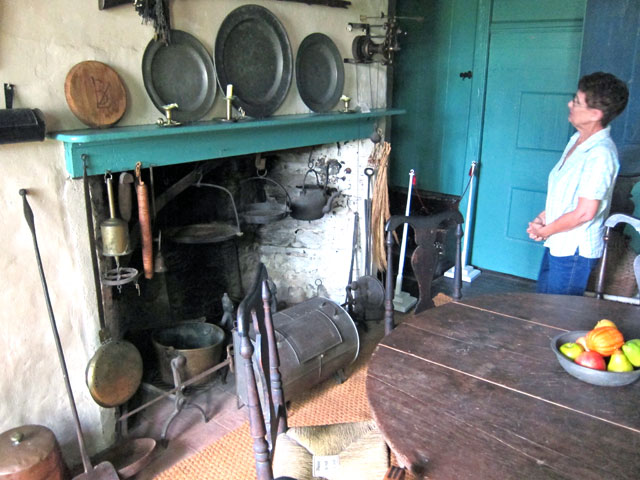
The docent told the history of the house, and the changes over time. In housing their collections, the various rooms are furnished reflecting different centuries as they would have appeared. Below is the 17th century kitchen with some interesting implements with clock mechanisms for roasting. One is on the wall above the mantle on the right, and the other hanging from the mantle on the left.

dut-3


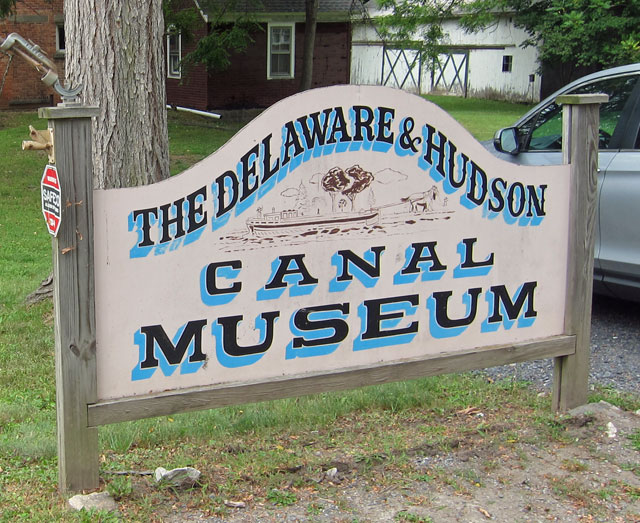
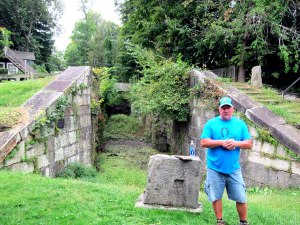
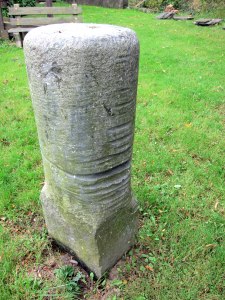
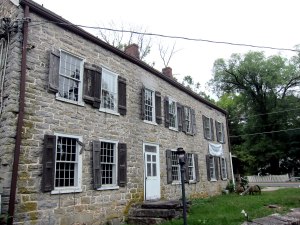
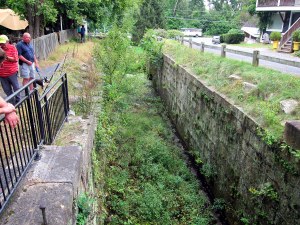
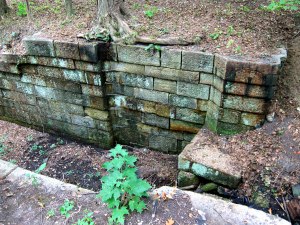
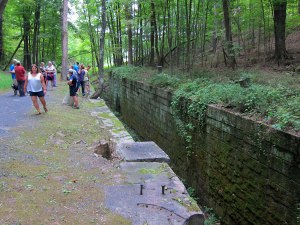
dut-4My main destination for the transit to Warwick, however, was the D&H Canal Museum and Five Locks Walk in High Falls, NY. I wanted to learn more about this canal after discovering it when traveling back from Scott and Betty’s. You know I am fascinated by canals, and this was a fantastic stop. Not only did I get to see the museum, but I was there on a day when there was a guided tour of the locks – I waited and joined in with about 30 other people.

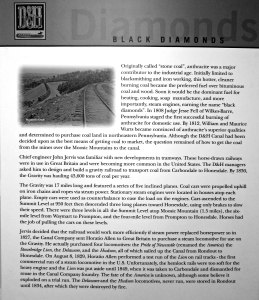
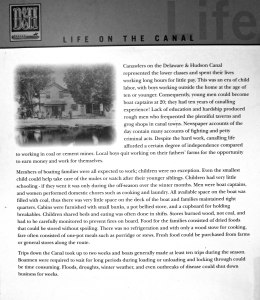
I thought it would be easiest to share these information panels from the museum (and save for my own further review and study). If you wish, you can click and open the gallery to read further.

The key historical fact you should take away from this post is that the War of 1812, cut off the US supply of soft bituminous coal from England. The coal was cheap fuel, even when brought across the Atlantic. The Wurt brothers soon proved that anthracite coal from Carbondale, Pennsylvania, was the answer, but how to get it to New York City? They built a  108 mile canal with 108 locks along rivers from Carbondale to Kingston, NY, where the coal was then transported to NYC and elsewhere. The easiest route – going east then north to go south. Even coal “shunpikes.”

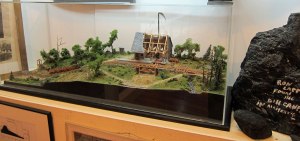
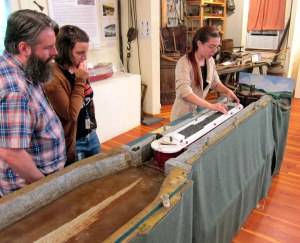
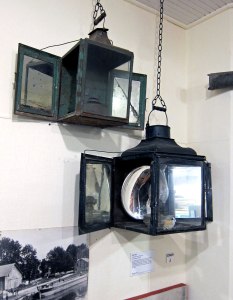
The museum was nicely done, but small. The 1797 DuPuy Canal House at Lock 16 was recently purchased, and is to be restored to house the museum. I will revisit when that is done. Joining the walking tour, I learned from the director and his assistant. Here is a gallery of views from the museum and along the walking tour of the 5 lock area. High Falls was one of the many towns that emerged with the building of the canal in 1828.  The last coal was transported in 1898.

It was then time to head to Warwick. WAZE routed me over the Shawangunk Mountains on back roads (WAZE knows me), and past the entrance to the Mohonk Mountain House where Cathy and I “honeymooned” in 1995. I need to get back someday for a stay. From New Paltz south I had some lovely views of the Shawangunks, and ultimately arrived at the Warwick Conference Center about 5PM – just in time – but aren’t I good at timing?

A great learning, visual, and gastronomic experience followed for the next 4 1/2 days. But, that will come in the next post on the Dutch in the Hudson Valley. By 11:30 AM on Friday the 23rd, I was back on the road with one goal in mind – Martin Van Buren’s home in Kinderhook, NY. Less than 30 miles from the Red Lion Inn, I have never been in the area at the right season, or the right day to tour the home. The 23rd was my opportunity. But also, I have become “hooked on” Washington Irving (more on that in the next post about Sunnyside and Sleepy Hollow), and Irving visited this home when owned by the Van Ness family, and later he visited and stayed with Van Buren.

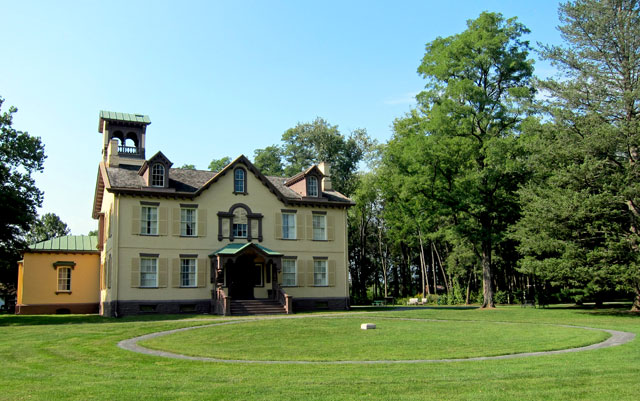
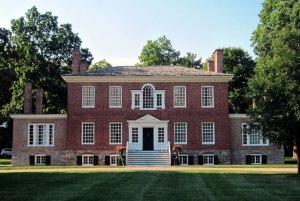
Martin Van Buren's Lindenwald in Kinderhook, NY

Martin Van Buren’s Lindenwald in Kinderhook, NY

Completed in 1797, Van Buren (1782-1862) purchased this home in 1839. As Scott and Betty will tell you, a game question coming up often is “which President was born, lived, and died in the same town?” Of course you guessed correctly, otherwise I would not have asked – Martin Van Buren (remember to share your winnings with us). The tower on the left is part of Van Buren’s later modifications. The home and tour was somewhat of a disappointment to me – but at least I have now been there. Restoration and furnishings are not the most impressive, and my volunteer guide was lacking. When I responded to her question, “which President was Van Buren?”  I replied, “our 8th President.” To which she replied, “yes, and he was followed by Lincoln, our 9th!”  NOT !!!

Located in Kinderhook, I had never been in Kinderhook before, and hope to return — it is lovely. And, also with my new interest in Washington Irving, there are connections between this village and The Legend of Sleepy Hollow. Here are some images of the home, and the village (remember to click to open slide show).

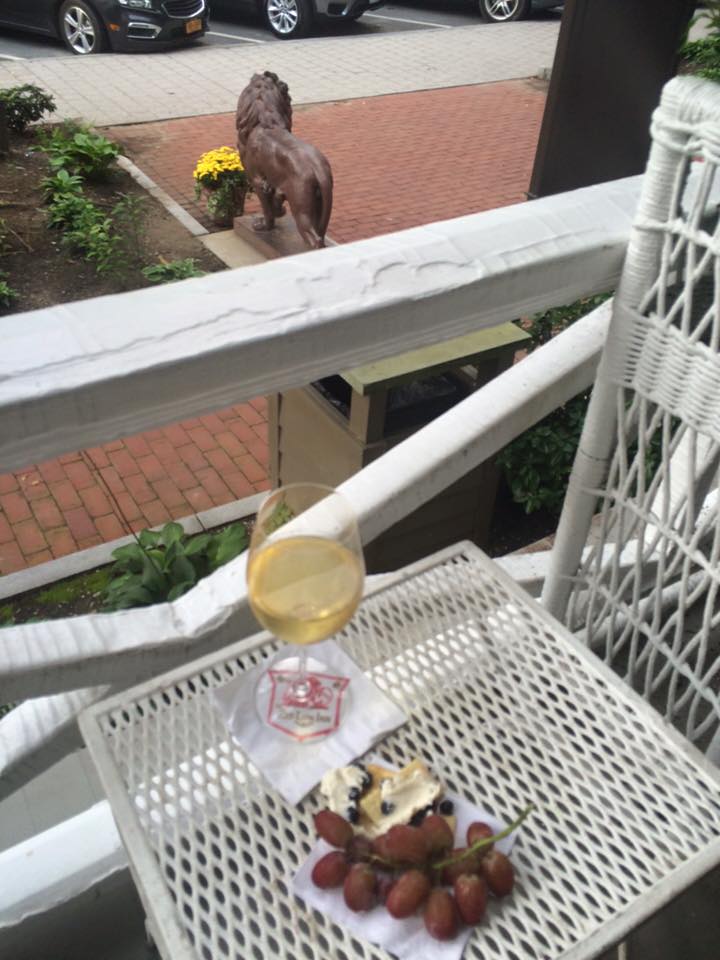
But, it was time to head home.  Did I say I was less than 30 miles to The Red Lion Inn? You know I stopped.

rli-sept-2016

And, then home, and now a week later reliving the fun.  Next coming is what happened in-between going and coming. Later, as always, yours, RAY

Posted in 2016-b Dutch in the Hudson River Valley | Tagged , , , , , , , , , , | 2 Comments

A NEW DISCOVERY AND “HIT AND MISS” – 10 SEPTEMBER 2016


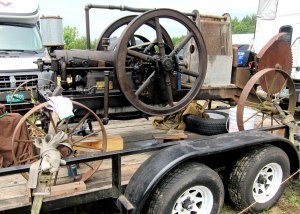
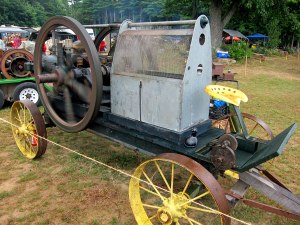
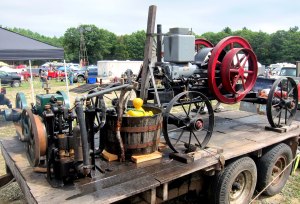
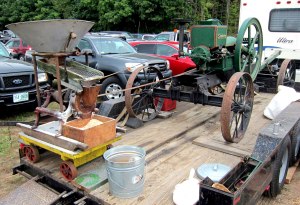
This weekend was the 45th Annual Dublin Gas Engine Meet in Dublin, NH, on Route 101. Fascinated for decades by the old “hit ‘n miss” engines, you may recall I went last year, and that Alex and I had a fantastic time at a similar show in Orange, Massachusetts in June of 2015. You may enjoy clicking on the links above to see some of what we saw.

BLUE BELLE and I tooled off through Keene and down Route 101 in spite of foreboding skies, arriving at 11AM. We had our $5 admission ready while in the queue to enter, but then the lady flagged us instead onto the field.  “We want you to exhibit your car, just pull in here instead, and park down on the left – no charge.” And, no argument – I was now parked right on the massive field, and off I went to see the vendor’s exhibits, and the machines on display and operating.

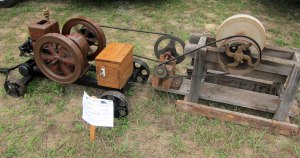
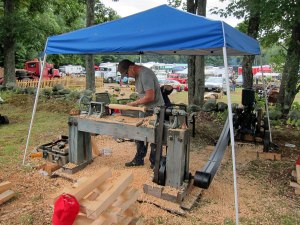
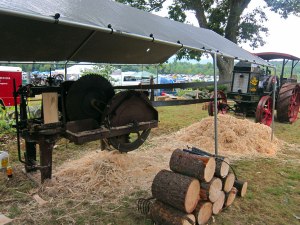
One vendor had a model of a machine I would have wanted, and when I went back hours later to make the purchase, it had been sold. I know, “meant to be” but also, “when you see it, get it.” Here is a gallery of some of the different machines I saw this time, and remember you can click on any one to start a show of larger images.

During one shower I moved BLUE BELLE under some trees at the side of the field. The rain was heavier, and people were leaving. I pulled her original top out for the second time ever to keep some water out of the cockpit. Eventually, the skies cleared, and at about 1:15 I decided to just head back home.

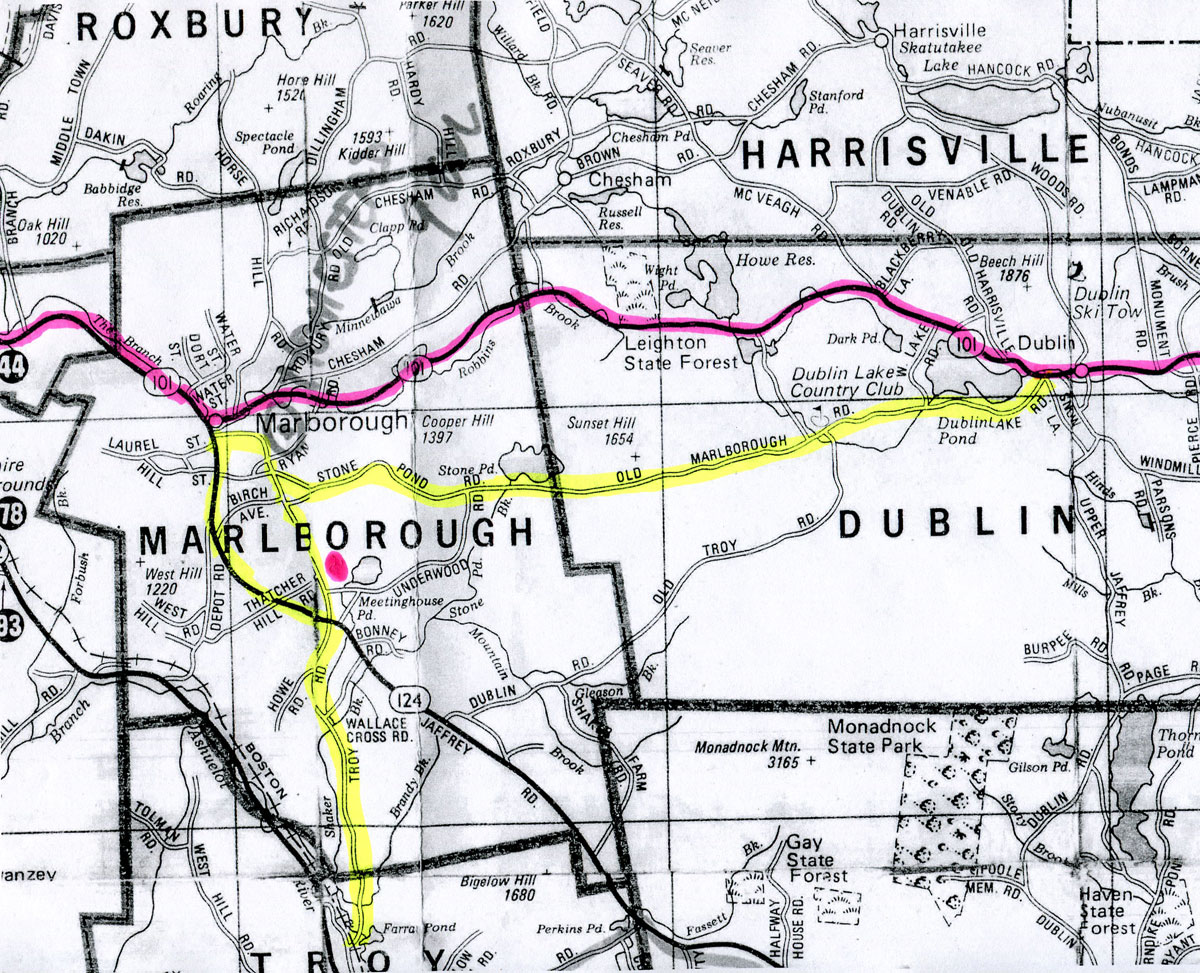
Back on Route 101, and heading west through Dublin. Up the hill, around the round-about at Yankee Publishing, up the hill, and coming into the curve at Dublin Pond. BUT WAIT !!! How many times have you gone east to west, or west to east across New Hampshire on Route 101? How many times have you looked across Dublin Pond from 101 to  Monadnock Mountain? Have you ever wondered what was on the other side of the lake? This time I did – and turned onto East Lake Road. REMEMBER – IF YOU HAVE NOT BEEN ON A ROAD BEFORE — TAKE IT !  Checking my extensive archives this morning, I found a used map of the area to share with you what I did.

Route 101 is in pink — what I did is in yellow — and your assignment is to pack a picnic lunch and bottle of wine and head to the pink circle on the back route I discovered. (you can click on the map for a larger size)  (PS – explore Harrisville when you can – absolutely amazing – someday I will have to give you a full photographic study)

marl-1

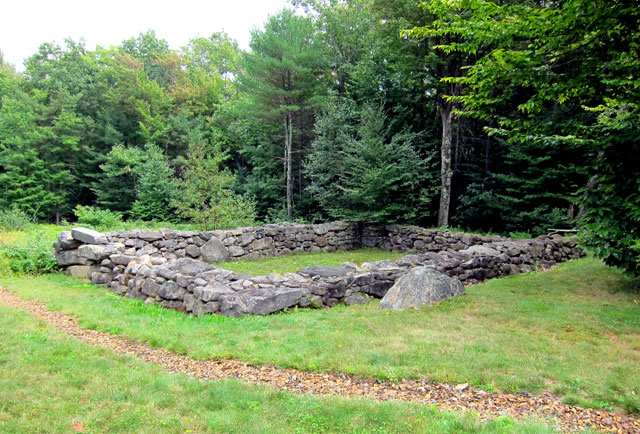
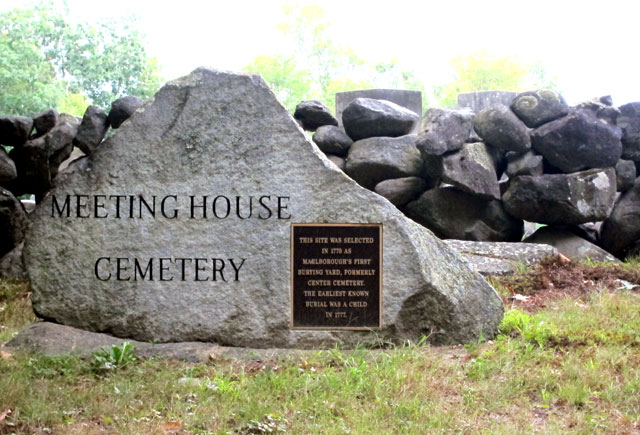
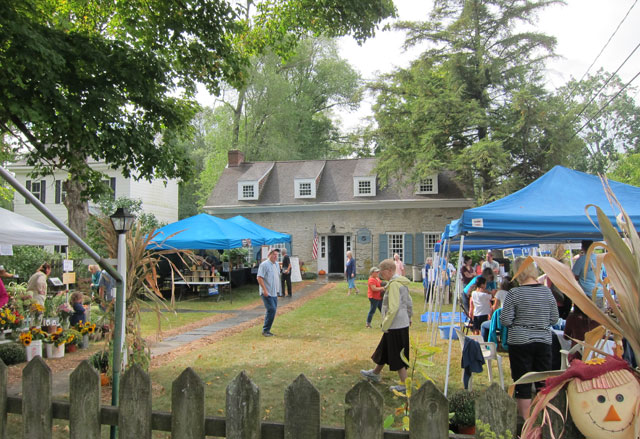
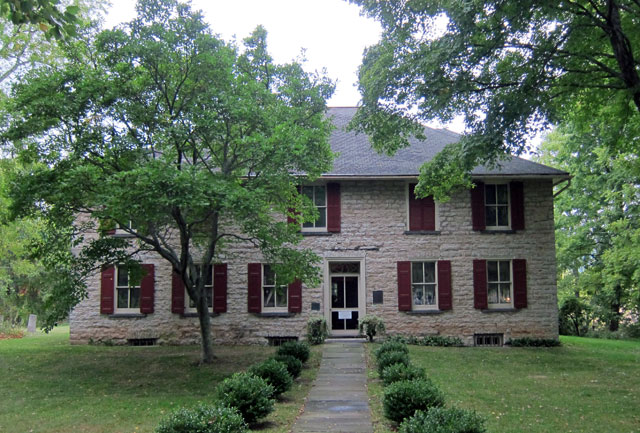
Lake Road is great, and different mountain views. And, YEAH, eventually became dirt. I was not concerned about getting lost. I knew I was in NH, and my sense of direction keeping me heading west. Eventually I would come to a familiar intersection.  The road became Stone Pond, and soon I had a choice – I kept to the right onto Colonial Road assuming it would get me back to Route 101 eventually. GLAD I DID – because at the stop sign at Frost Hill Road, looking to my left was a sign “Historic Cemetery – Historic Site – 1 Mile.” Left turn, and up the hill I roared. I passed three wonderful period homes, and then arrived at the cemetery, and historic site – the original Marlborough Village – the pink circle above.

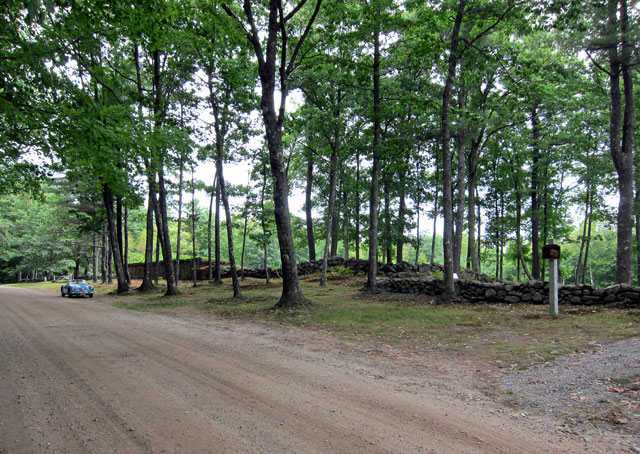
One of the most beautiful spots I have visited. BB2 parked in front of the cemetery and village site.

One of the most beautiful spots I have visited. BB2 parked in front of the cemetery and village site.

dub-9

The above can be “clicked” for a larger readable version.

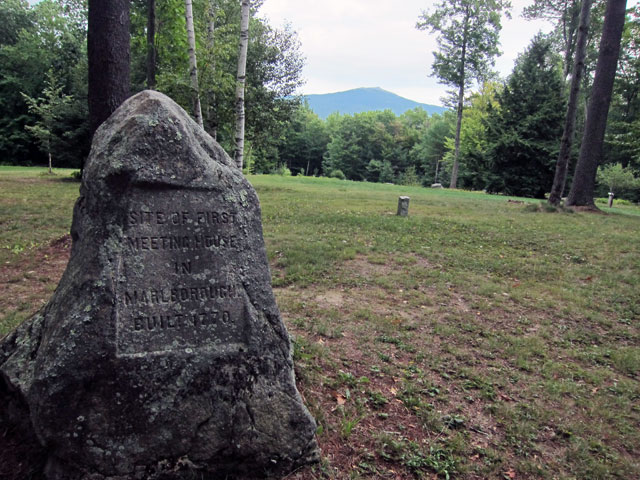
This is the site of the Old Meeting House with Mount Monadnock in the distance. Construction began in 1770 with completion in 1779. It was last used in the 1840s, and in 1865 fell down due to the lack of repairs.

dub-11

At the edge of the village site (walk from spot above towards the mountain) is the Town Pound. Found in most colonial villages, the pound was for impounding stray farm animals. A farmer could reclaim his animal paying a fee to the Pound Keeper for the animal’s care and feeding.

dub-12

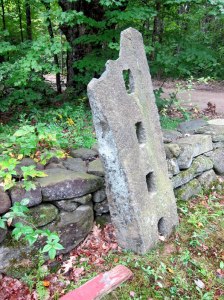
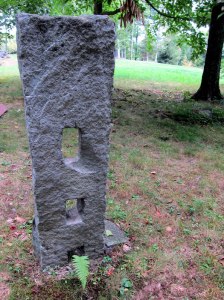
I could not resist sharing these granite fence/gate posts. At the fantastic three homes and fields north of the original village there are many more such cut stones in current use.

dub-15

and, most unbelievable, and the first time I had ever seen vaults like these, these family vaults have stone doors which have been sealed. Further south there was another similar number of vaults.

dub-16

Back to my map above.  I had to know if and where Frost Hill Road joined with Route 101, so back past the fantastic estates, fields, and views, and yes past the Frost Free Library the road intersects with Route 101 at the eastern edge of the commercial area. My guess is that the Marlborough we know today, is where it is today because of the river and water power usage to run the mills. The population and village just moved down the hill abandoning the original site.

But before I went down the hill, I continued south on Frost Hill Road and came to Route 124. Reversing direction, Frost Hill Road ultimately connects with Route 124 at Route 101 (hope this makes sense). So, I headed back out this time on Route 124 toward Jaffrey (filling in the map) until I arrived back at Frost Hill Road where instead of continuing to Jaffrey I turned on Old Troy Road, to head to Troy and Route 12. Arriving on 12, it was time to head home.

WHAT A GREAT DISCOVERY. Between Old Marborough Road and Frost Hill Road there are views of Mtn. Monadnock that most people do not see.

RAY HIGHLY RECOMMENDS – IF YOU HAVE NOT BEEN ON A ROAD, OR THE OTHER SIDE OF THE LAKE — DO NOT WAIT

And, plan a picnic at the Original Town Center of Marlborough. You will not be disappointed.  Enjoy, yours, RAY

Posted in Day (or maybe two) Trips, ROADS and ROUTES | Tagged , , , , , , , | 5 Comments

BONUS DAY – BONUS 164 KILOMETERS WITH BLUE BELLE – 5 SEPTEMBER 2016

Happy Labor Day. You may be caught in traffic – I was not, as I am in “heaven.” I expected today to be bad weather wise with the storm that hit the south earlier in the week, but I was proven wrong. Saturday I had a “date” with one friend in BLACK BEAUTY. She suggested a sojourn to Peterborough, and lunch there. Well, hurry and go to Nature’s Green Grocer Market and Cafe. The most amazing selections in their market, and the cafe – AMAZING. We sat on the patio eating, listening to the river. I felt like I was back on my waterfall in New Preston, CT. We backroaded home via Harrisville, and some more roads I had not been on. She is good at saying — “Did you see that sign? TURN THERE!” But she “chickened out” in the wilderness on the way to Cobb Hill Estate. Sunday, I had another “date” with a dear friend, and we traveled to (no surprise here) Plymouth Notch, Vermont, to hear a Folk and Blues Festival at the Calvin Coolidge site. It was BLUE BELLE’s turn to Plymouth Notch.

Today I planned to “work” at home — but, “work” can wait – the weather was going to be nice. So, out came the map, and soon a route was formulated on unexplored areas to “fill in the map.”  And, this map will “set the stage” for today’s 164 kilometers.

LD-20

By the way, Vermont and New Hampshire are very generous with their maps – they want tourism. When, and if, you ever see Massachusetts or Connecticut state issued maps, grab them — no grab 6 or more, and send me a few.

I crossed the Connecticut River, drove through Saxtons River arriving in Grafton. You may know the significance the Inn at Grafton holds for me. It changed my life, and that story is on rayboasbookseller.com.

The Inn at Grafton, Vermont and the Phelps Barn Tavern

The Inn at Grafton, Vermont and the Phelps Barn Tavern

I headed out of town on VT 121 – usually I only head into town on this route from Route 11 outside Londonderry. I love this road ! And, so do my ladies — DIRT ! Who cares about paint jobs and dust – just have fun!

For those of you who do not know what schooling is like in our area, here is a small school on this road.

LD-2

And, then downtown Houghtonville — well, this is downtown Houghtonville.

LD-3

And, here is just a typical bucolic setting along Route 121, and it is for sale.

LD-4

There is a four corners I had never turned on, and today was the day. I assumed Windham Hill Road would take me to West Townsend on Route 30 – and I was correct. Excitingly, it was all down hill. Eventually I saw (and pulled in) to the Windham Hill Inn. I had been here once before coming up from Route 30 – it is a setting in one of Archer Mayor’s mysteries.  And, then I arrived at the intersection on Route 30, and for the first time went inside the store.

LD-5

You know I love old country stores.  Nothing special inside as to originality and decoration, but if hungry a place to stop and eat. BUT, inside was a flyer (you know I have a massive travel library) for exploring Vermont Byways via GyPSyGuide. I have yet to download the app — Gypsy Guide Vermont — but it appears that once you load it you can get commentary while traveling the state — and when not in range of cell service (duh – majority of Vermont) as it works off GPS which is free.  Check out Vermontvacation.com/byways and get the app — I will play with it once I get this post off to you.

In the parking area was this sign. Taft and Coolidge – WOW.

LD-6

Approaching Wardsboro I saw I sign for Our Lady Of Ephesus House of Prayer. Cathy and I traveled there several times, including a wonderful Christmas celebration. But, since it’s address is Jamaica, Vermont, I was not able to find it a couple years ago when touring a friend in Vermont. Well, postal address may be Jamaica, but the turn is off Route 100 in Wardsboro.

LD-7

Some more dirt, yeah, and BLUE BELLE and I arrived.

LD-8

I had packed a lunch (cucumber and tomato sandwiches – good for my figure), and figured I would find the perfect spot to lunch. This was it, and there was a gazebo with table and chairs. Here is the view from the gazebo while BLUE BELLE was resting while I ate.

LD-9

And, a few views of this shrine replicating Mary’s last residence in Ephesus, Turkey. I have been to Ephesus, but with a tour, and only got to the old ruins not to her home site.

Then, back to Route 100, and crossing it on the back road (is there any way else?) to South Wardsboro. Ends up that South Wardsboro is three, maybe four homes (hard to tell when they are falling down) but I wanted the left turn to Newfane. That exciting dirt road is all down hill — again, down hill – I do not remember going up hill all day. And, I arrived in Newfane eventually, the Windham County Seat.

LD-14

Typical and wonderful New England. Have any idea why I love it here?

LD-15

I then headed down Route 30, and past the Dummerston Covered Bridge.  I have not been south of the Dummerston Covered Bridge on Route 30 in maybe 16-18 years – no need to have done so.  And, I reconfirmed, nothing there, unless you are going up or down Route 30 from Brattleboro to points north.

But, I scooted off Route 30 before getting downtown. Would you believe I found dirt roads in Brattleboro?  Yes, up around the country club. My ladies know the kind of roads they prefer, and can find them. We eventually worked our way down to Route 9 and then into downtown Brattleboro and up US 5 to cross the bridge into New Hampshire.

Not done yet, I turned left to head home on River Road – yes along the Connecticut River. First you approach the old community house which now houses a theater on the second floor. I have attended a show here. Great, yes?

LD-16

And, the old store in West Chesterfield, NH. I probably ran such a store in my previous life.

LD-17

Tooling down River Road (maybe over the speed limit) I saw a monument. Brakes, U-turn, and here is the site of the first house in West Chesterfield on the Connecticut River in 1761.

LD-18

Going through the county complex area (prison abandoned, nursing home status in the air) I needed to turn down Ferry Road.  On my list is to write about the Connecticut River Ferry Landings in my area. But, alas, no definitive spot for that, however, I did find a built up elevation over the river which is the site of the Cheshire County Alms House Cemetery – 1867. Now another research and writing project.

LD-19

It was home about 3:30, and I sat down to document today for my memory and to share with you. But more importantly to encourage you to journey and explore the same route. If not this route — JUST GET OUT THERE, EXPLORE AND ENJOY.

It is getting harder to explore alone. Today was alone, but tomorrow will make up for it because I have “two dates” for tomorrow’s adventure.  That will be written about — and I still have a week in Maine (22-26 August) to share with you.

Take care, be safe, and just enjoy every moment to the fullest. I am trying to do so. As always, yours, RAY


Posted in Day (or maybe two) Trips, ROADS and ROUTES | Tagged , , , , , , , , | 2 Comments

CONNECTICUT EXPLORATIONS – 10 – 12 AUGUST 2016

I returned home from my home state of Connecticut a week ago, and am finally starting on this post. But I know it may not be finished for days. In fact, I may not complete it until I am on the next series of explorations.  Am I too busy, or what? Actually, I talked with Betty yesterday following her visit with Scott to Grant’s Cottage (which I strongly encouraged).  I complimented her on her wonderful writing and woven past two travel posts. “But, Ray,” she said, “they took me 5 to 6 hours each.”  “I know,” I replied, “to do it right…” Make sure you visit Airstream Touring with Scott and Betty.

I grew up in Connecticut and left for college, so that is 18 years. Cathy and I married, and returned in 1995 until the fortunate move to Walpole in 2002 – thus 7 more years for a total of 25 — more than 1/3 of my life.  But, hard to believe, I have not done it all in Connecticut.  So, I formulated a plan, booked a fantastic B&B, and off I went Wednesday, August 10th.  This will be a picture show to encourage your travels – the history comes with the visit.

It poured on my way down I-91 to my first stop – the Connecticut Trolley Museum in East

Connecticut Trolley Museum

Connecticut Trolley Museum

Windsor. Fascinated with trolleys in about 7th grade, I got my parents to take me to the Branford Trolley Museum, and in September 2012, I experienced the Seashore Trolley Museum in Kennebunkport, Maine.  My afternoon in Kennebunkport was amazing, the Connecticut Trolley Museum was a disappointment, as I reported on TripAdvisor – but at least I can say I was there.

I sat in the car in the rain before I finally decided to go inside – I thought most everything would be outside. I was wrong.  In fact, there was very little to see inside, and little outside.

About half the trolleys on exhibit.

About half the trolleys on exhibit.

The absolute best thing was the documentary film on the history of trolley transportation in the US. Probably done in the early 70s I was captivated.  I also enjoyed seeing this car from the Springfield Vermont Railway I need to learn more because the placard stated it crossed the Connecticut River on what is the current old toll bridge to meet the train on the NH side of the river.

Combination passenger and freight car of the Springfield Electric Railway

Combination passenger and freight car of the Springfield Electric Railway

Passenger area of the Springfield Electric Railway car.

Passenger area of the Springfield Electric Railway car.

Note that the cars are original – I like original. The rain had stopped, so I headed outside for a ride.
On site also is the Connecticut Fire Museum — essentially a Butler Building full of retired equipment.

CT-14

I then crossed the Connecticut River to backroad to my next destination. I always assumed Windsor Locks was so named for canal locks.  You know my affinity for canals, and low and behold there was the canal along the west side of the river. I later learned that this is the Enfield Canal (1829) that enabled river traffic above the Enfield Falls.

Did you even wonder why Bradley International Airport is named Bradley?  You should have. Here is the reason why.

CT-15

Lt. Bradley in the early days of the field died in the first crash there.  The above plaque is just inside the New England Air Museum — which RAY HIGHLY RECOMMENDS. I wore myself out in a couple hours, and would like to return – easy to do since the museum is on the north side of the airport.

There are three hangers with displays, and then some aircraft outside on display. In its early days of construction, most aircraft were outside awaiting restoration. A freak hurricane came up in 1979 destroying much of the aircraft awaiting housing in the museum to be built, and opened in 1981. But, what is there is amazing.  You first enter the military hanger.

Military Hanger - NE Air Museum.

Military Hanger – NE Air Museum.

The 57th Fighter Group has an impressive number of firsts:

CT-17

I knew a former short-time Walpole resident, Stu Bailey, was instrumental with the museum, but here on display is the oldest Wright Aircraft engine that he and his brother restored and donated.

CT-18

In this second hanger is all history, and I absolute flipped out when I saw:

CT-19

In my Did You Know That… article on page 18 of the April 2016 issue of THE WALPOLE CLARION, I discussed this balloonist.  There prominently displayed was Silas M. Brooks’ Balloon Basket, circa 1870. A pioneer balloonist from Plymouth, Connecticut, he lived from 1824-1906, and flew all over the area. The card on the display reads in part “…It is the oldest surviving balloon basket, and the oldest surviving aircraft in the United States.”   I encourage you to read my April article, could this be the same basket that hovered over the Walpole Town House on October 8, 1871, snatching and escaping with Walpole’s Revere Bell? We will probably never know for sure. I am including this discovery in the September issue of the CLARION.

In the “history” hanger is this gondola from a Blimp that patrolled the coast during WWII. I was waiting for the man to get out of the way, and then I realized — what a great way to give you an idea of the size.  I will remember that.

CT-21

And, this was a great model.
CT-23

The last hanger has the restored B-29 Bomber that was flipped over in the hurricane, complete with nose art – appropriate for a general rated audience

CT-22

The B-29 Superfortress Bomber was the most sophisticated, complicated and expensive weapon produced by the US during WWII, and successfully rushed into production.

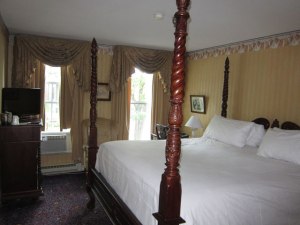
And, then I headed to my B&B the Nehemiah Brainer House in Haddam, Connecticut, probably one of the best I have stayed at, if not the best. Exquisite appointments, antiques, comfort, and wonderful hosts.  Here is a view when I got back from dinner my first night.

Nehemiah Brainerd House B&B, Haddam, CT

Nehemiah Brainerd House B&B, Haddam, CT

And, you know I like to share my room and meals. You can click on any image to open to large ones.

Any further questions why “I do” B&Bs?

Before dinner that first night, I headed to Camp Hazen in Chester where I attended the YMCA camp in 1958 and 1959 (don’t do the math). The fantastic camp will celebrate 100 years in 2020. As I pulled in the director’s husband followed me in and we had a wonderful nostalgic chat. I stopped years ago with Cathy when we spent a night in Essex, and I will visit again.

And, dinner was wonderful at the Brushmill in Chester. I would love to go again with company.

Brushmill at Chester, Connecticut

Brushmill at Chester, Connecticut

My meal, albeit alone —

CT-32

I awoke on Thursday wondering if my day was going to be a “wash-out.”  My plan was to start the day on the Essex Steam Train and Riverboat excursion. For over a week ahead I debated which trip I should book ahead (planning on the last), but never did.  In true Ray fashion, I arrived and took the first train out at 10AM instead of the last train of the day (sounds like a song title). The rain stopped, and it was a great day with rain returning when I returned to my B&B.

Essex Connecticut Steam Train

Essex Connecticut Steam Train

When purchasing your ticket, you can choose an open car, coach, or …

you know I selected FIRST CLASS

CT-39

A view along the way heading up the Connecticut River on the west bank.

CT-40

you pass the boat landing, but will stop to board on the way back.

CT-41

the cruise on the river is very bucolic with lots of birds, including eagles. Here is Gillette Castle from the river (more on this later) and a very early ferry crossing.

CT-42

they really have the schedules down to a system as one train debarks passengers for the riverboat, others depart the riverboat to return to the station by train.  I overheard a conductor say my train had about 200 passengers (probably low due to rain at the day’s outset) and the normal number of passengers is 500-600.

CT-44

CT-45

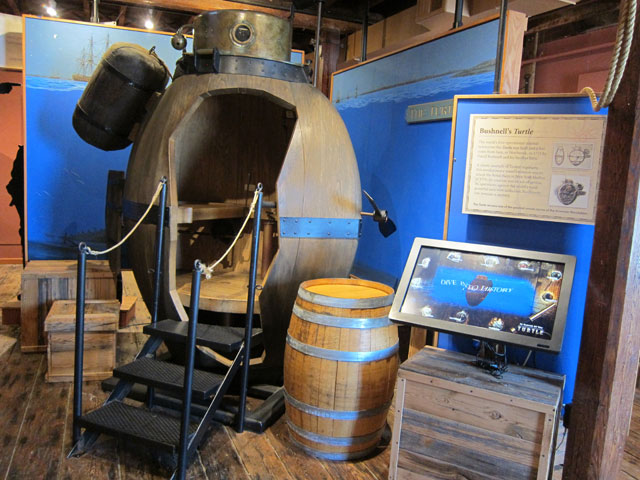
Getting back to the station after 1:30, I got a sandwich there and headed to my other planned adventure for the day, the Connecticut River Museum, arriving about 2:15. On the list for a long time, I highly recommend a visit to Village of Essex itself, and the museum. On the first floor is the history of discovery of the area, and Bushnell’s Turtle.

Model of Bushnell's TURTLE in the Connecticut River Museum.

Model of Bushnell’s TURTLE in the Connecticut River Museum.

After US Navy Supply Corps School, my first assignment was as Disbursing Officer aboard the USS Bushnell AS-15, named for David Bushnell. Bushnell’s invention was to place bombs to the hulls of British warships in New York’s harbor while submerged, to be exploded with a time delay fuse once the operator had safely retreated in the Turtle. Unfortunately, on September 7, 1776, the augur used to penetrate the ship’s hull, to then attach the underwater bomb, hit metal failing to make a connection. Two additional attempts were unsuccessful, but the submarine had been invented as a war machine.

When I purchased my admission ticket, the clerk encouraged me to take the stairwell to the third floor to see the mural of the 400 plus mile long Connecticut River with accompanying aerial photographs.  Having travelled from the Canadian border to Long Island Sound observing most of the River, I was thrilled seeing the mural and photographs taken in 2009. I recognized most locations, and learned a few things I did not know. Here is just one small part of the mural —

CT-48

And, some aerial photos that you can “click on” to see larger:

Years ago, Cathy and I spent a night and nice dinner at the Griswold Inn in Essex, open since 1776. At that time, in their dinner room was a popcorn wagon that is probably my CORNELIA’s sister.

Griswold Inn, Essex, Connecticut, established 1776.

Griswold Inn, Essex, Connecticut, established 1776.

Then I headed back to the little village of Chester which is now really an arts center in the quaint buildings. The recommended restaurant was booked, so I had dinner in the nearby pub for about half the price – and it was good.

Just like with Rogers’s Island Museum at Fort Edwards, NY again this June, I have never been in the area of Gillette Castle in Hadlyme at the right time or day — but now was the day and time, and the plan to be on the grounds before the castle opened. But, first I crossed the Connecticut River to walk the grounds of the Goodspeed Opera House in East Haddam.

GOODSPEED OPERA HOUSE - East Haddam, CT

GOODSPEED OPERA HOUSE – East Haddam, CT

And, more views to tempt your road trip – hey, I know the perfect B&B across the river.


And, then I arrived on the grounds of Gillette Castle just before it opened to view.

CT-61

Chances are, since you are young (and things and people are generational), you have no idea who William Gillette is, well was. An eminent actor and playwright (1853-1937). Think iconic Sherlock Holmes. Gillette in bringing Holmes to the stage in over 1300 performances introduced the Deerstalker cap, curved briar pipe, Inverness cape, and the phrase “Elementary my dear Watson.” His wife died on a train with a ruptured appendix, and never re-marrying, he lived on his yacht, but then saw this spot on the Connecticut River. In 1919 he completed this impressive home at a cost of well over $1,000,000. In 1938, the State of Connecticut acquired the castle and land creating a wonderful park. The interior and furnishings of the castle are as they were when Gillette died – a virtual time-capsule (seems like I have seen many such time-capsules recently).

Here is the view of the river from the front patio.

CT-62

And the grand main room.

CT-63

He had many innovations throughout, and even glued his mementos down so his roaming cats would not knock things over. Gillette had an intricate system of mirrors so he could decide whether to come down to greet a guest or not, and to watch guests try to get into his bar which he secretly secured before retiring to watch them try to get that second drink he said they may have. Each of his 47 doors was hand carved, and each one is different.


After this enjoyable two hour visit (including a video and nice little museum on Gillette’s life) it was off north to Hartford (not a song title) to visit the Mark Twain House, acclaimed by National Georgraphic as “one of the the ten best historic homes in the world.” Well, I checked this list, have a ways to go, but I have documented some wonderful places on my “pages” here. But, I was not as impressed as I guess I should have been.

Mark Twain House - Hartford, CT

Mark Twain House – Hartford, CT

No pictures allowed inside. Nice tour, but I really enjoyed the museum giving a time line of Samuel Clemens’ life and work. I will now have to read my copy of Dayton Duncan and Ken Burns’ MARK TWAIN.

It was time to venture home, and true to form the rains began once I was done. I have been busy since, and am completing this post 17 days after returning – but as you know I am writing for myself to refresh my memories. While I am waiting for Alex to awake for a day’s adventure, I will start on last week’s Maine excursion, but first here is a discovery I promised to my Facebook readers.

A BONUS FROM 3 AUGUST

Following my 3 month back surgery check-up (all is healing well) I was going to take an overnight with “glacial explorations,” but decided not to, focusing instead on re-tracing Connecticut steps. But, I couldn’t go straight home, so looked at the map — there was somewhat isolated square landmass nearby I had not explored. Dilemma solved!

PARADE GROUND - HANOVER CENTER, NH

PARADE GROUND – HANOVER CENTER, NH

Look at your NH state map. Just above Lebanon there is a relatively open area. I headed east on US 4 from Dartmouth Hospital to the intersection with Goose Pond Road, where I turned north. Goose Pond and its early cottages is a bucolic drive at 20 MPH. Once past the pond, the road turned dirt, telephone poles ceased, and soon I noticed on my Iphone “NO SERVICE.” But, Scott, I learned the answer to the question we pondered. WAZE still continued to display moving maps, and GPS was spotting where I was. So, the program loads when it can, and GPS triangulation is not cell signal dependent. You see on the map Hanover Center and Etna – I had never seen them. I turned left on Hanover Center Road, and climbed the hill. And soon I arrived to find the center of the center – the five acre Military Parade Ground established in 1795. Hanover Center is a village of Hanover (yes, home of Dartmouth College), but I bet few ever see it, or the village of Etna just to the south.

CT-1

From Etna, I figured that Trescott Road would work me back towards the Hanover we are all familiar with. At a T, I turned left on Wheelock Street, and soon was on the south perimeter of the Dartmouth College Campus and the main town. I simply continued to cross the Connecticut River into Vermont.

Antiquing in Queechie was fruitless — when will I finally give up, there is nothing anymore. But I decided to finish up at Vermont Salvage in White River Junction. Sadly no fountains. Home next, to study for the Connecticut fun.

RAY RECOMMENDS: IF YOU HAVE NOT BEEN ON A ROAD, OR EXPLORED AN AREA — DO IT NOW, You will never know what you will find, and you are “filling in the map.”

Posted in Day (or maybe two) Trips, ROADS and ROUTES | Tagged , , , , , , , , , , , , , , , , , , | 5 Comments

POCONO and OLD MINE ROAD EXPLORATIONS – 16-19 JULY 2016

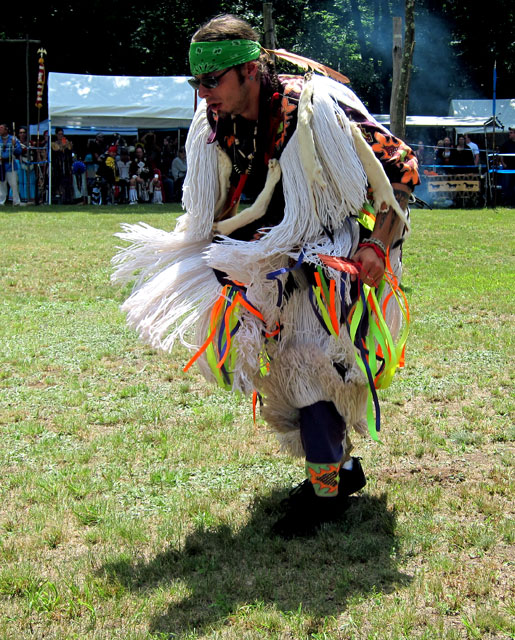
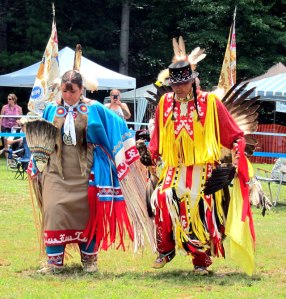
I was way overdue for a visit with Scott and Betty at their home on a lake in the Poconos. I have shared with you many of our adventures together – Scott and my Cathy worked together for years, and it has been wonderful to have them still as close friends. We picked the dates for my visit, and they started searching for new adventures in their area (of course, we could have just sat on the deck and talked).  Scott found an Inter-Tribal Native American POW-WOW that weekend, right in an unfamiliar area of their town. The plan was hatched for Sunday, July 17 – none of us had been to a POW-WOW before.

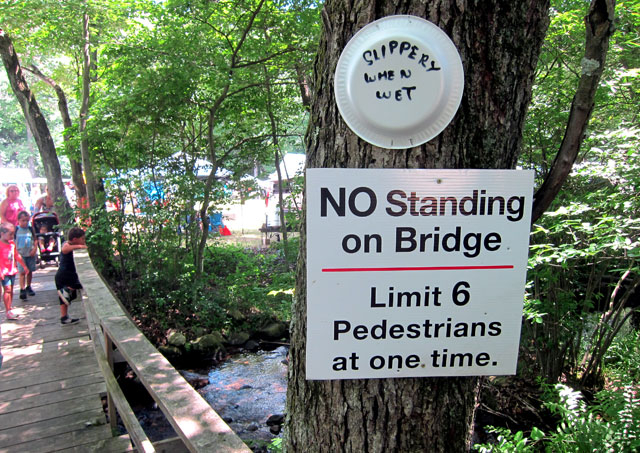
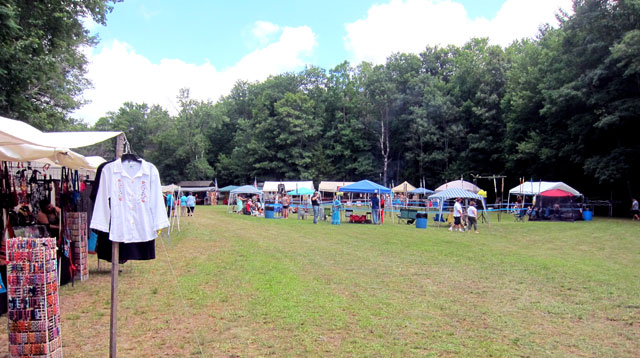
DPA-1With festivities beginning at Noon, we arrived with our chairs at the scout camp early to get a good seat. After reading and heeding this warning, we crossed this bridge into the open area for the ceremonies and ubiquitous vendors.

DPA-2

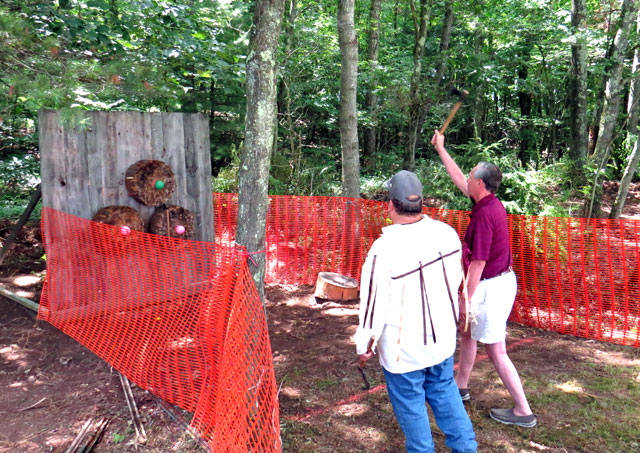
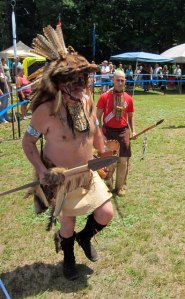
We looked, but none of us needed any tchotchkes. But I could not resist a $1 donation to throw a tomahawk. I have no idea why Scott didn’t take this action shot while facing me!

DPA-9

Prior to the beginning of the ceremony, the first dance is symbolic of stamping down the grasses to facilitate the following dances.

DPA-3

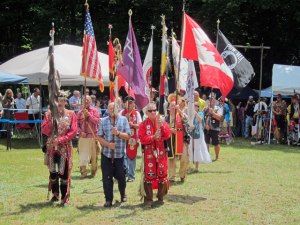
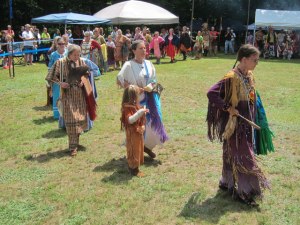
Then the opening ceremonial parade and many dances with LittleWolf & SummerBird, and Matt White Eagle & Chris Mourning Dove, and others. (you can click to enlarge)

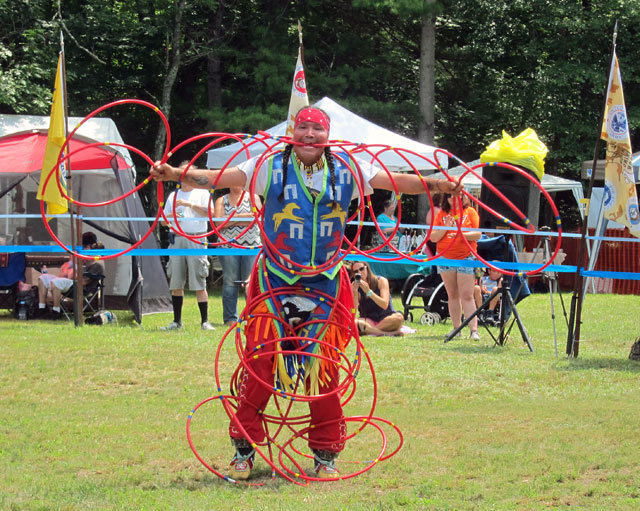
Everything was pretty much the same, with the public invited to join in. We heard a “hoop dance” was coming, so waited for that – fascinating. Matt White Eagle, from Canada, travels all over the country to perform. He dances and uses increasing numbers of hoops (originally made of a white ash, but painted red) to intricately present recognizable designs.

DPA-8

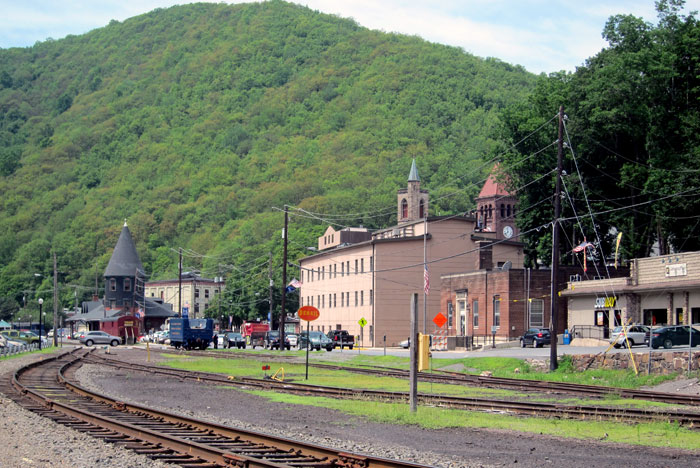
A peaceful evening on the deck with dinner followed, the plan for Monday was my desire to see Jim Thorpe, PA, which I have read about, and admired the history and Victorian architecture. We arrived in the valley along the Lehigh River at about 11:41 am the 18th.

DPA-10

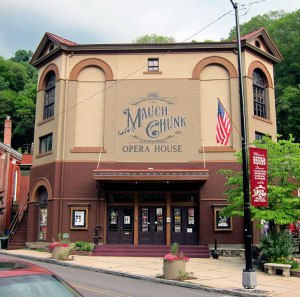
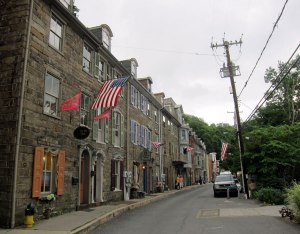
Mauch Chunk, PA and East Mauch Chunk became Jim Thorpe, PA in 1955. Mauch Chunk had been considered “Switzerland of America” by the Swiss Tourist Board, but even without this designation I implore you to learn of its history and visit. Anthracite coal was first discovered in 1791 in nearby Summit Hill. To bring it down into town, in 1828, the second railway in the US – the Mauch Chunk Gravity Railway – brought the coal to town to then be transported by canal to Philadelphia and New York.

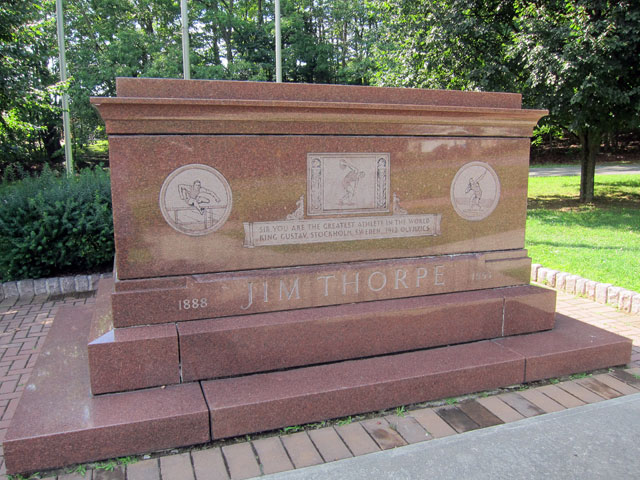
When early 20th century renowned athlete and Olympian, Native American Jim Thorpe died in 1953, his wife became angry with his home state of Oklahoma for its unwillingness to erect a memorial to him (read about the early controversy following him from the 1912 Olympics). Hearing that Mauch Chunk and East Mauch Chunk wanted to establish a tourist trade to their towns, Thorpe’s widow made a deal with them. She provided his remains in exchange for a memorial and renaming of the towns – and that probably made the difference. But, we were surprised that the memorial is on the outskirts of East Mauch Chunk about as far away from the Victorian town attractions as possible.

Remember to click to enlarge images.

Actually, we found the memorial on our way out of town five hours later. We first toured the untouched Victorian town.

The main attraction is the Asa Packer Mansion that overlooks the National Historic District. Asa Packer arrived in Mauch Chunk in 1833 becoming owner of a canal boat, and later expanding his canal business transporting coal in his Lehigh Valley Railroad. In 1861, he built this mansion.

DPA-21

Which over looks the town. Next door he built a home for his son (now a B&B, and murder mystery weekend venue – been dying to do one – pun intended)

We did the tour first. No photos allowed inside, but I bought a booklet of images, but you can google “Asa Packer Mansion Images.” Maybe sometime I will have time to add from the postcards I bought. But here are some very important fast facts about this family.

When Asa died in 1879, there were 26 millionaires in the US, and 13 of them were living in Mauch Chunk! His widow inherited 54 million dollars, but an 1856 Pennsylvania state law stated she could not keep the money unless she was married. She asked the local train station attendant to marry her, her fortune was secure, and she divorced him 6 months later, but with an nice settlement and annuity (I can be seen hanging around train stations now). There is a table in the parlor that Queen Victoria gave Sarah Packer when Sarah was visiting in London. At that time Queen Victoria was the wealthiest woman in the world, and Sarah Packer was the second wealthiest. In 1865, Asa gave the funds to start Lehigh University. Tuition was free from 1871-1891, and graduates were offered jobs on Asa’s Lehigh Valley Railroad.

When Sarah died in 1882 the home passed to her daughter Mary Packer Cummings. Mary died in 1912, leaving the mansion and its furnishings to “the Borough of Mauch Chunk and its successors.” Essentially unchanged from its construction in 1861 to 1912, the borough did not know what to do with the mansion and covered all the furnishings, boarded up the windows, and unknowingly created a Victorian time capsule for 40 years.

In the mid-1950s, the local Lions Club approached the borough about opening the mansion as a museum, and that happened in 1956. I cannot help but think that was in conjunction with the name change of the community to stimulate tourism. On the tour we were told that the chandelier in the mansion was copied for the movie, GONE WITH THE WIND, but in fact checking I cannot substantiate that claim – remember, at that time the mansion was boarded up. But, substantiated is the claim that Disney used Packer’s son’s home as a model for its Haunted Mansion.

Asking about a structure on top of a mountain, I was given directions, and from that vantage point we had a view back to Jim Thorpe.

DPA-25

You can see the red roof to Asa Packer’s mansion, East Mauch Chunk to the right, and there was a whole new area on the “hill” above the mansion we did not know about. Of course, we headed there to explore too.

If I could have found a biography of Asa Packer I would be reading it now instead of writing this post. I need to go back to Jim Thorpe, PA – and I cannot overstate, RAY RECOMMENDS – VISIT THERE SOON.

Dinner that evening we experienced Powerhouse Eatery in White Haven, PA. Originally  the power plant for the White Haven Sanatorium which closed by 1976, it was renovated as a restaurant in 1989. My evening special, the Halibut, was amazing.

DPA-28

Jim Thorpe, PA, is on US Route 209. I was conflicted on how to meander home on Tuesday (stopping at the Red Lion Inn, of course), and one option was to travel US 209 through the Delaware River Water Gap – had not been there in awhile. Well, Scott and I looked at an atlas. He and Betty are shunpikers, and even more exotic than I. For example, in Alaska with their Airstream they traveled 28 miles down a dirt road (subject to washout) to an abandoned WWII airfield where camping was allowed. And, on departure, yes, the road was washed out. Now that is shunpiking!!! Looking at an atlas, Scott pointed out that US 209 north of Port Jervis, NY, was a designated scenic road. I had not been through that section of geography before — decision made.

DPA-29


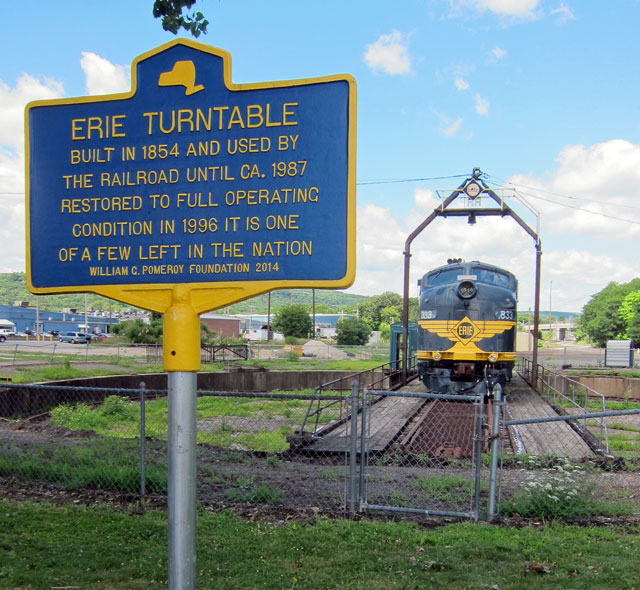
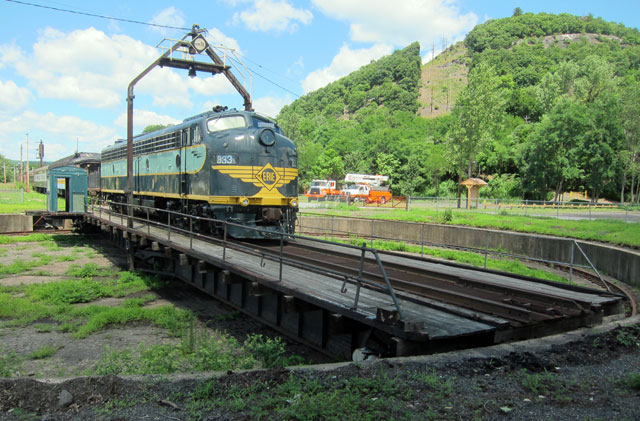
No rush leaving on Tuesday, and I arrived in Port Jervis, NY, shortly after noon, and saw a sign for the Erie RR turntable. With my interest in railroads, I had to see it.


DPA-30

With possibly less than 500 left in the country – I now have another quest along with canals and locks to document and show you. Of course, we have one of the best (still in use) right here in Walpole at the Green Mountain Railroad roundhouse.

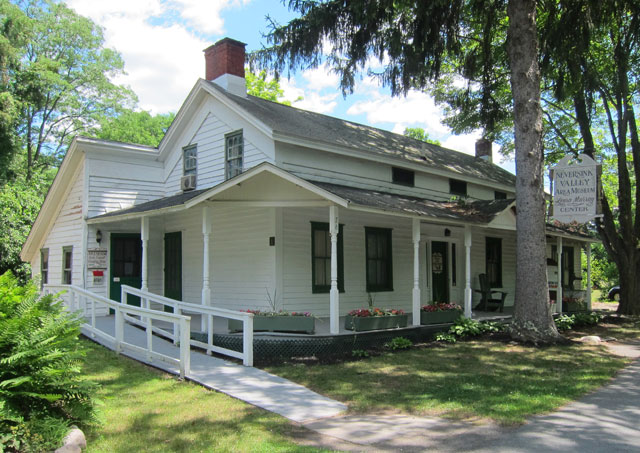
Neversink Valley Museum - Cuddebackville, NY (yes I spelled it correctly)

Neversink Valley Museum – Cuddebackville, NY (yes I spelled it correctly)

Once I got north of Port Jervis life became more rural and scenic as the map proclaimed. There was one historical marker after another. Ends up that US 209 is one of the original federal roads established in 1926, and follows the Old Mine Road from Colonial times which followed Native American trails. The Dutch when arriving in the area developed the road from Lenapi trails in their search for furs and minerals. And, guess what? Much of the Delaware and Hudson Canal traverses this route from Port Jervis to Kingston, NY. Great suggestion, Scott, and a repeat trip is in order. I first stumbled into the Neverskink Valley Museum (sadly open only weekends) which has much on the D&H Canal and is in a small complex of original canal buildings at a point where a wood aqueduct designed by Roebling crossed.

Country Store in Wurtsboro, NY

Country Store in Wurtsboro, NY


The Wurts brothers were instrumental in the development of the canal, and a common practice was to name canal towns after those involved. This country store in Wurtsboro dates to canal days, and there was lots of “eye candy” inside.


Five miles up the road was the Delaware & Hudson Canal Linear Park, and I stopped. Here is the canal and towpath looking north with part of the remaining buildings in the distance.

D&H Linear Canal Park. Near Summitville, NY

D&H Linear Canal Park. Near Summitville, NY

Mules (sometimes horses) would pull the barges about 20 miles a day (3,000 miles per season) often eating and sleeping along the way. Local residents were fascinated with the canal with boats being pulled by animals. They enjoyed leisurely family walks, or courting strolls along the path. It was discouraged by the D&H, but Sundays the canal was closed. One information panel discussed all the historical sites in Sullivan County – and I have to get back – but on a weekend when things are open.

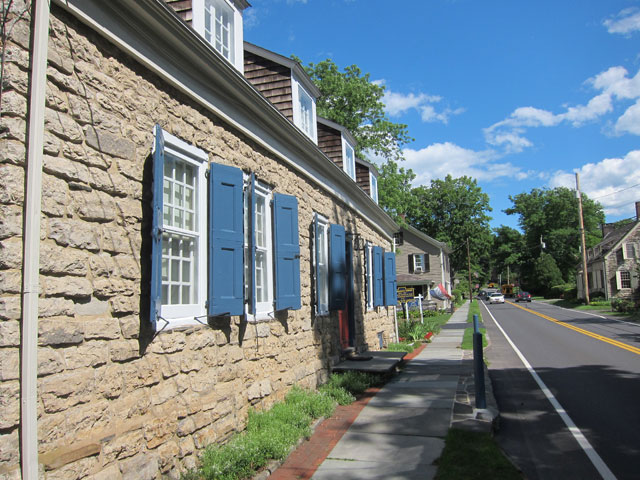
Getting closer to Kingston became more built up and historic. I pulled into Hurley (after passing all the stone houses in Stone Ridge) and enjoyed the stone buildings, including one where George Washington was entertained. Here is a typical street view in Hurley.


Stone Houses - Hurley, NY

Stone Houses – Hurley, NY

It was late afternoon. US 209 has been rebuilt around and bypassing Kingston ending at NY 199 to cross the Hudson on the Kingston-Rhinecliff Bridge built in 1957. Working my way across the state to Massachusetts, I stopped (as planned, of course) at the Red Lion Inn to take in the atmosphere for awhile.

DPA-36

Scott and Betty earlier this year finished their second stint as National Park Volunteer Rangers at the LBJ ranch. During our visit, Scott showed me their copy of a NPS “bible” – INTERPRETING OUR HERITAGE by Freeman Tilden. I immediately ordered my copy, and it arrived the other day. Museums must not just be a statement of facts, the idea now is to stimulate further investigation. Tilden defines interpretation:

An educational activity which aims to reveal meanings and relationships through the use of original objects, by firsthand experience, and by illustrative media, rather than simply to communicate factual information.

he continues: Interpretation should capitalize mere curiosity for the enrichment of the human mind and spirit.

I hope in some small way, my ramblings will encourage your curiosity to explore, and learn and enjoy more.

And, I promised you an answer.  I saw Chris at the library yesterday. Her guess was way off, and she needed to know.  Remember the “hook” I gave you last post to read further?

THE "HOOK" - What is it? Keep reading.

THE “HOOK” – What is it? Keep reading.

You ready? Remember I was at the NH Farm Museum — this is a HAY CAP – a pressed paper unit placed on top of a hay stack to keep water from entering the center of the stack.

DPA-37

So, now you know. So keep exploring, and I will keep sharing my explorations with you. Thank you, and enjoy, yours, RAY

Posted in Day (or maybe two) Trips | Tagged , , , , , , , , , , , , , , | 3 Comments

MAINLY MAINE – HISTORIC OVERNIGHT – 7-8 July 2016

THE "HOOK" - What is it? Keep reading.

THE “HOOK” – What is it? Keep reading.

I know, I know – July is almost over, and I am reporting two and a half weeks late. And, I even have a three nighter from last week to document before month end.  You see, I go away, learn of books I need to read, buy those books, read them, research more on where I have been, and finally get to tell you about what I did. And, then too, I had to finish the August issue of THE WALPOLE CLARION. Recently I have been worried about giving you too many pictures (and too many words), but I have to show you things I have not seen, and if I haven’t seen them, my bet is you have not also. So, as time passes from an adventure, hopefully I trim down the number of images, and pare down the words, becoming more concise. So, here goes…

Having had almost a year of difficult walking, back surgery, and a longer hospital stay than planned, I have been hesitant to get “back on the road,” but the “best way to get something done is to begin.” I saw a news report about 19th CENTURY WILLOWBROOK VILLAGE in Newfield, Maine, and knowing nothing of it said, “Ray, off you go.”

Willowbrook Village

Willowbrook Village

Newfield is in southwestern Maine. Looking at my New Hampshire map for a backroad to the area I noticed Route 28 crossing US 4 and US 202 outside Concord. Not having been on that route, that was the plan to work north above Lake Winnipesaukee ( (get your map out) I stopped in Alton Bay for lunch – always love visiting there) to Route 16, to head east on Route 25 into Maine.

Remember that many roads today bypass the towns they originally bisected (thus Walpole was saved by the Route 12 bypass in 1962). I saw the sign pointing to Pittsfield to the right, and turned.

Main Street - Pittsfield, NH

Main Street – Pittsfield, NH

I parked on Main Street, and started going from one historical plaque to another, reading and photographing. The architecture was (is) amazing. Rounding the corner to Carroll Street, I found the Frank Lyman Park with maps and tour booklets (watch out WHS – I have an idea). On the front cover of PITTSFIELD’S HISTORIC TRAIL (just found it on-line – check it out) is printed: “Step back in time to the Nineteenth Century.  This 1.5 mile walking trail encompasses nearly all of the features found in any New England community over 100 years ago:  homes, churches, schools, industrial and commercial buildings as well as dams and bridges. Unlike elsewhere, however, most of the original buildings remain the same as when they were constructed.” I enjoyed touring around, and reading many of the 35 cast aluminum plaques. A return more thorough visit is in order, and RAY RECOMMENDS – spend some time exploring Pittsfield, NH.

Remember to click on any of the above to see larger images.

I was going to cut over to head north on Route 153, but taking a wrong turn ended up in Wolfeboro where I then continued north to pick up Route 25 east. When I got to Route 153 I thought, “well, at least I can see Effingham even though I did not come up 153 all the way.”  Well, I got to Effingham, and guess what? I realized I had been there on a great trip on 153 in September 2014 You need to get to the bottom of that great post (yes, some are better than others) to read of Route 153, and I did not share Effingham, NH at that time. (NOTE – RAY RECOMMENDS TRAVEL NH ROUTE 153)

This time I explored more in Effingham, learned more, and am sharing.

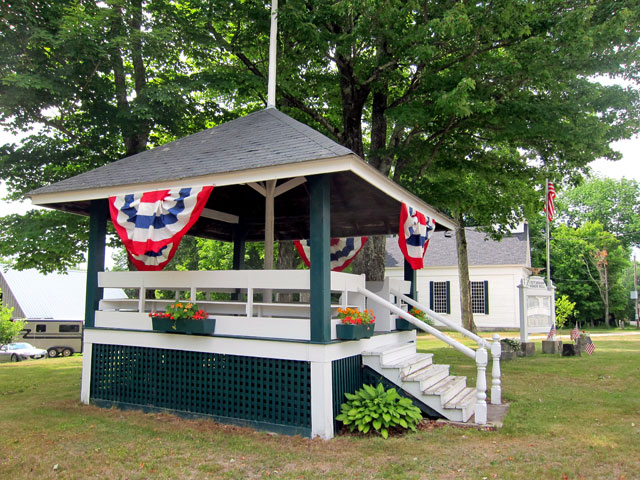
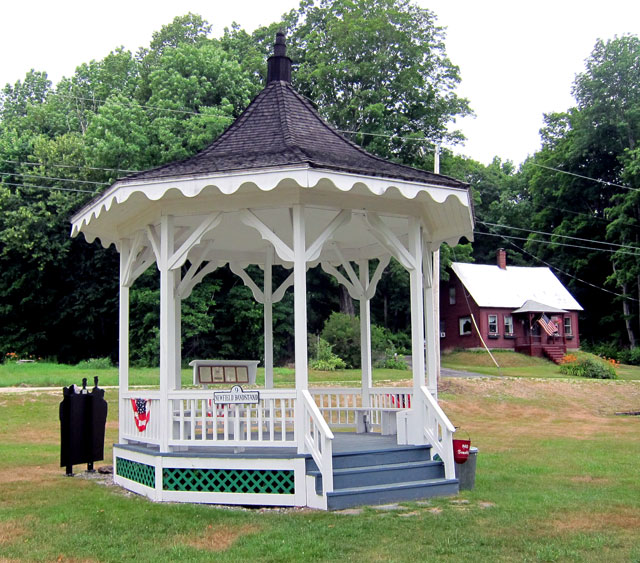
Effingham, NH, Bandstand - A Bandstand as it should be.

Effingham, NH, Bandstand – A Bandstand as it should be.

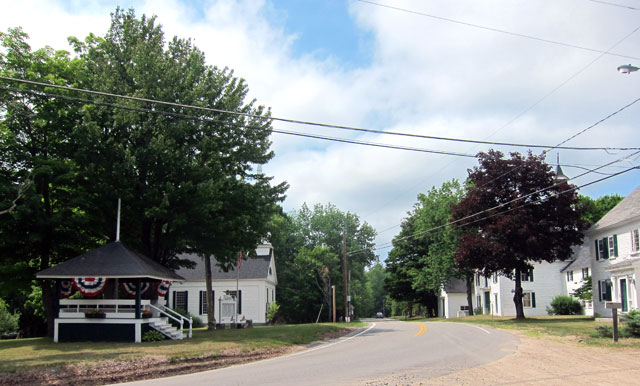
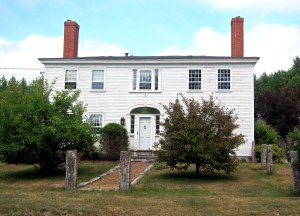
Virtually untouched, there are 21 colonial era properties in the historic district. Just off Route 153 the First Normal School in New Hampshire, and next door the Lord Mansion, one of the largest period homes I have seen with massive attached barns and carriage sheds.

Downtown Effingham, New Hampshire

Downtown Effingham, New Hampshire

RAY RECOMMENDS — Visit Effingham, New Hampshire

Back to Route 25 east, crossing into Maine – only to find much of nothing (I had been hoping to score big at antique shops). With few lodging choices in the area, I had made a reservation at The Cornish Inn – yes, in Cornish, Maine. Arriving at 3pm, my key and a note had been left on the newell post, so I left my things, and then walked around town looking at some shops – decent ones for a change.

The Cornish Inn and Lincoln Pub - Cornish, Maine

The Cornish Inn and Lincoln Pub – Cornish, Maine

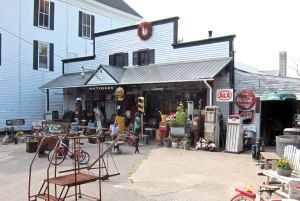
The antiques were great, pricey, and anything I would have wanted, I already own. Across the street was this great shop, and the interior had been a country store.

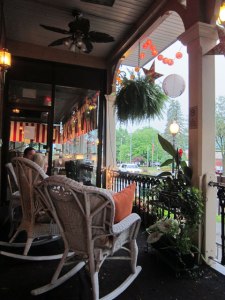
Closing the last shop at 5pm, and since my Inn’s dining room had been closed for the evening (was planning to eat there), I headed further east to see Sebago Lake. I recently saw a Home and Garden TV show searching for homes on the lake and wanted to see it, and there had to be a restaurant on the water. There was not, and I can now say I saw Sebago Lake. I found a so-so old inn for dinner on the way back to Cornish, and when I returned, I planted myself on the porch to read and write in the rain.

CM-16

After a nice breakfast at the inn on Friday morning the 8th, I headed for my destination in Newfield – 19th CENTURY WILLOWBROOK VILLAGE.

CM-18

There a few minutes before opening time, I struck up a conversation with a gentleman outside the old country store – now the entrance and gift shop on the left above. Ends up he is the museum director, and between my questions and our similar interests, it was an hour before I got to purchasing my ticket. I had to know the history of why the museum was there (I always have to know why something or a town is where it is). Don King bought the main farm in 1965 for use as a hunting lodge, but then began collecting farm implements and the like to save the items from the dump. He began restoring things, and in May, 1970 decided to open his museum. Most fascinating, I learned that most of Newfield was lost in 1947 – the year that Maine burned. It was suggested that I read WILDFIRE LOOSE by Joyce Butler.  I ordered it that night, and when it arrived could not put it down. You have no idea what you will learn about fires, and wonderful neighbors helping neighbors. Having visited the past few years in all the locales mentioned, I could place the action. Extremely well written, RAY RECOMMENDS – get WILDFIRE LOOSE, and devour it. Including time for lunch at their nice sandwich shop, I spent 2 1/2 hours on the grounds once I got started after visiting with the director.

Great exhibits, but the absolute best is the unique 1894 Armitage-Herschell Carousel. Fourteen years of restoration, it was installed in 1991. Packed away in a barn for decades by the original owner, this carousel travelled extensively to fairs in the area. In has 26 horses that with mechanisms rock back and forth rather than going up and down. At the time, carousels were only for adults – NO CHILDREN. For modesty, women had to ride  sidesaddle on the inside horses. In the building is also the original steam engine (now propelled by compressed air) and the original ticket booth, complete with original tickets – the red building you see in my video)

CM-22


Few of these may exist, and this is the most complete outfit in existence, and worth the visit.

You enter the village in the country store – and you know me and country stores (goodness, I may have never shown you the country store I have recreated in my bookshop – something to share with you someday – a 45 year plus fascination).

CM-19

Upstairs is the original meeting and dance hall, with walls decorated in 1924 in the Rufus Porter style.

CM-20

In the front corner was a collection of cameras and projectors. I have examples of half of the ones shown below – yes, another fascination.

CM-21

Some wonderful farm related exhibits in the barns connected to the country store. Then you walk down the road (no traffic) to the adjoining area for more exhibits, and the print shop – yes you know another passion.

CM-27

And, I had never seen these large folding one-man saws before, so have to share.

CM-28

And, with all the hit-‘n’miss equipment I have seen in the past couple years, I never saw a saw (no pun intended) attached in this way.

CM-29

And, another “appropriate” band stand.

CM-30

When I was planning my route to Maine, I saw on the map — New Hamspshire Farm Museum, which I knew nothing about. It was on the way home in Milton, so backroading away I went arriving about 2:30.

NH Farm Museum, Milton, NH

NH Farm Museum, Milton, NH

The docent shared with me the win-win situation of the museum’s establishment. The last heir of the farm died, and her will called for destruction of the 18th century complex since she wanted no one else to live there. The existing farm museum non-profit had no home, and a NH Court battle broke the will, and the museum bought the property preserving it to tell the story of agriculture and rural life in New Hampshire over three hundred years.

At one time, the home served as a tavern, here refurnished as it would have been used. Note the floor cloth – I am partial to them.

CM-32

And there are fascinating exhibits in the 104 long, three story barn. So much I had never seen before.

Someone has ATTITUDE !!!

CM-38

And, this ten-foot building led to more research, another book purchase, and I can tell you that these buildings were all over New England serving as “shoe factories.”  You go research.

CM-39

And, finally, hopefully I “hooked” you with this image.  Well, I am going to get to work on my trip to Scott and Betty’s in Pennsylvania. What is it below?  I will tell you in the next post. Thanks for reading, yours, RAY


THE "HOOK" - What is it? Keep reading.

THE “HOOK” – What is it? Keep reading.

RAY RECOMMENDS – Don’t rush, but if in the area do visit WILLOWBROOK VILLAGE and the NEW HAMPSHIRE FARM MUSEUM

Posted in Day (or maybe two) Trips, ROADS and ROUTES | Tagged , , , , , , , , , , , | 4 Comments

JULY 4, 2016 — WHERE WOULD I BE? – PLYMOUTH NOTCH, VERMONT

Yes, tradition is wonderful, and I was back in Plymouth Notch, VT, for the third time on the 4th of July to help celebrate President Calvin Coolidge’s 144th birthday, and our Declaration of Independence. If you want historical details, search for any of my many other posts on this bucolic spot where our 30th President was born, and is unchanged since he was inaugurated President here in the early morning hours of August 3, 1923. Rural 1923 Vermont typifies the 1880s elsewhere in the US – I love it, but you know that. So, this is a visual post, and here is what you missed today along with the largest crowd I had ever seen here.

July 4, 2016 Parade about to begin in Plymouth Notch Heading to the Coolidge gravesite

July 4, 2016 Parade about to begin in Plymouth Notch Heading to the Coolidge gravesite

PN-2

"Parade" heading out of the village for the cemetery.

“Parade” heading out of the village for the cemetery.

DRESSED FOR THE OCCASION

PN-4

THREE GENERATIONS OF THE COOLIDGE FAMILY AWAITING FOR THE CEREMONY TO BEGIN

PN-5

Wreath from the White House.

Wreath from the White House.

The Placing of the Wreath which was followed by short speeches and quotes from Coolidge’s speeches – impressive to say the least of this unsung hero.

PN-7

And, back in town I caught Regional Site Administrator, Bill Jenney, bringing Calvin’s cake out. It is always so wonderful to be warmly greeted by Bill — thank you, Bill.

PN-8

 Around the village were crafter’s demonstrations, the buildings were open, and there is always a wagon ride. The garden was wonderful, and I need to get the folks who do this garden to teach me – please! (remember, you can click on an image for larger size)

Backroads home to avoid the backroad – over the hill to Reading and down Route 106 – for the first time this stone jumped out (well, I noticed a car pulled over to the side of  road, and my eyes followed).

In 1918 these stones were placed in this position by descendants of Capt. James Johnson

In 1918 these stones were placed in this position by descendants of Capt. James Johnson

And the plaque on the road reads as below. This Indian raid in Charlestown (just north of me at Fort No. 4) is a classic tale of the French and Indian War, and worthy of further study by me.

PN-16

PN-17

All for now — but more coming — Happy 4th of July – yours, RAY

Posted in Day (or maybe two) Trips, Plymouth Notch, Vermont | Tagged , , , , , | 4 Comments

TWO NIGHT EXPERIMENT – SARATOGA SPRINGS – 28-30 JUNE 2016

When I began writing this after 21 hours “on the road,” I felt my experiment was going very well. Comfortable for a couple hours in the car driving, two hours on my feet in a car museum, and a long walk for dinner and back.

The past year I have been studying and studying Road Scholar booklets, pulling out trips that interested me, but nothing has compared with the 11-12 unique trips, learning adventures, that I have taken. One trip interested me, five days in Saratoga Springs learning the history of the resort and springs, and touring around. But I studied the itinerary in detail and found I had done more than half the things on their list (Gary graduated from Skidmore, and five years ago lived a couple months here, and I visited) And, with my knowledge of the history of the area, and summer resorts, I probably could give their lectures. Solution – make my own trip, stay in the same historic inn, and do what I had not yet crossed off the list. Sorry for the long intro – jump to images if you wish.

Tuesday I headed across Vermont on Route 9, and once crossing into New York State, SS-1turned right on Farmers Inn Road to “backroad” the rest of the way. Get your maps, I crisscrossed over hills to NY 22, headed north a tad to follow NY 67 west at Eagle Bridge. Big antique center on the corner – lots of stuff, exorbitant prices – and nothing entered the van. This route to Mechanicsville follows a river and rail line, and as a result Johnsonville and Schaghitcoke are old (but very small) industrial and rail centers. I turned at a historic sign to the Buskirks Bridge, and had to share the unique window coverings with you – probably to keep water off the bridge decking, but provide light.

SS-2

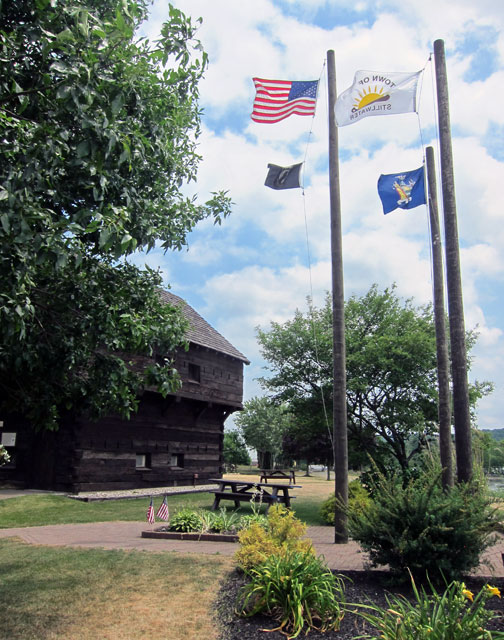
Crossing the Hudson River at Mechanicville, I turned north on US 4, not having been that far south on the road before. But, arriving in Stillwater, NY, I realized that I had traveled south that far when I visited Gary 5 years ago because there was the Blockhouse on the Hudson. Closed, but I did see it on my last visit. Originally built in 1927 as the original visitor center for the Saratoga National Park, it was moved here in 1999. Worth a stop if traveling past when open. (remember, on my smaller images you can click to enlarge). Continuing north on US 4, I turned west on Route 29 for Saratoga Springs. On the way I stopped at the National Park to clarify some questions I had.

“On my list” for Tuesday was the National Museum of Racing, and the Saratoga Automobile Museum. Not enough time to do both, so since it was open later, off I went to the auto museum located on the grounds of Saratoga Spa State Park.  With FDR’s interest in spas and the health from their waters, he awarded via the Reconstruction Finance Corporation (precursor to the New Deal) $3,200,000 to New York State to build the complex in 1933 (great link for the history). The last building constructed on the spa

SS-4 grounds was the spring water bottling plant, completed in 1935. Life changes, as we know, and with waning public interest, the spa began its decline in the 1960s. It became a state park in 1962. In 1971 the bottling plant closed and became storage. In 2000, the state leased the building to the Saratoga Automobile Museum, founded in 1998. The museum’s doors opened June 1, 2002.

A small museum, but worth 2-3 hours if auto history is of your interest. The current special exhibit is on Sam Posey – a fascinating man: artist, author, auto racer at Lime Rock and elsewhere, and on and on. Here is his 1954 Mercedes-Benz Gull Wing.

SS-5

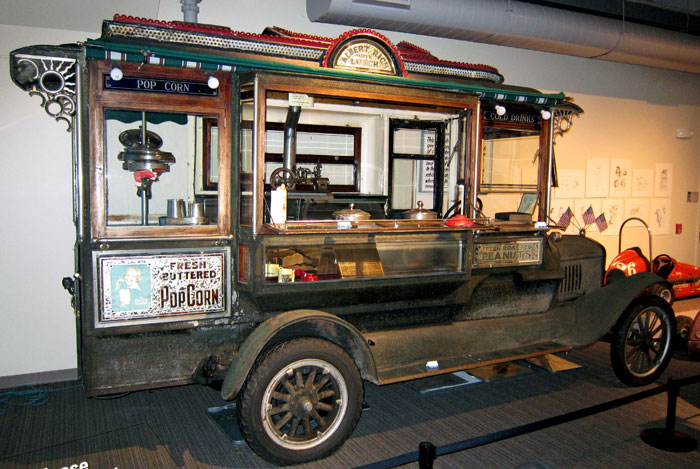
In the corner of the first floor (you can see it sticking up to the top left of the image above) is one of my favorite things, and was I thrilled to see it preserved here. For decades I have visited the Rich’s Model T Ford Cretors Popcorn wagon on Route 22 in Cambridge, NY — and here it is!!! Specially made for Rich in 1925, when he died his daughter still operated it until her death. It went into storage in 1997, and the museum obtained it in 2007.  You know me with popcorn wagons, so bear with me (you can open the gallery for larger size images).

SS-8

SS-11

In conjunction with the Sam Posey exhibit there were additional race cars. Upstairs are two permanent exhibits: East of Detroit (autos made in New York); and, Racing in New York. I loved the history in the East of Detroit exhibit. Great history, and brought back some memories, for example, the Maxwell was built on the river in Tarrytown, New York starting in 1903. From 1918 to 1996 General Motors assembled vehicles there (the plant you can see north of the Tappan Zee Bridge). In the late 1950s or early 1960s my Dad’s car club had an exclusive tour there which I remember.

This 1928 air-cooled Franklin was made in New York. Charles A. Lindberg courted his wife in this car. Learning that Henry Ford wanted the car, Lindberg had it mechanically checked, and drove it all night from New Jersey to Dearborn, MI, in 1940, to give it to Ford for his museum.

SS-12

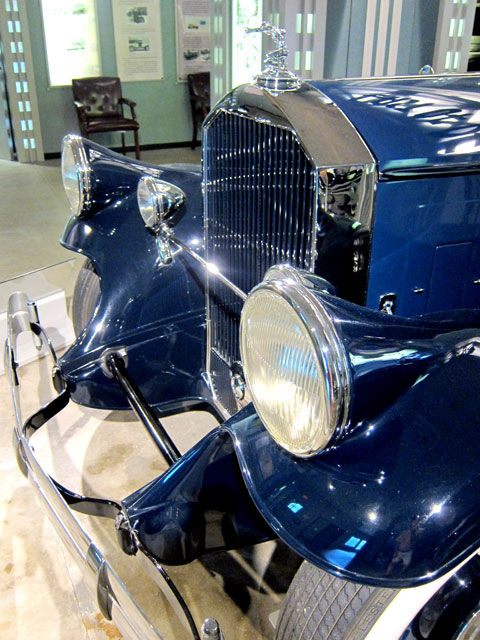
Also built in New York was the Piece Arrow. This 1931 model below shows headlights in the fenders, but I will always remember that it was in 1913 that the Pierce Arrows was the first car ever to have headlights built into the fenders. Why will I remember? Thank you for asking. In 1957, I was on Giant Step, a kids TV program hosted by Bert Parks. I missed out on “a free college education, and upon graduation a world-tour” provided by General Mills. The question I did not know the answer to? What was the first car with headlights in the fenders? I did not win top prize, however, I am pleased with how my life worked out – no regrets.

SS-13

Of course, like every pre-teen I wanted to enter the Soap Box Derby race. Never did, but I did take some old buggy wheels, attached them to 2x6s, built various bodies, and raced (albeit slowly) done Partrick Lane, and a bad hill and blind curve on Nod Hill Road in Wilton (now straightened) just below the now Weir Farm National Historic Site (where I used to play, and one time in the barn, one of the caretaker’s kids just missed me with a pitchfork – oh, the silly games kids used to play, and survive). The racer below was the best built in 1951.

SS-14

Back in the racing exhibit were more vehicles Posey raced, and this one that said Bob Sharp Motors. I knew that name, and was correct. Bob Sharp was from Wilton and built a car dealership on Route 7 (which you know is my favorite road in the US as you get further north). There was a great Ferrari, Alex remind me to send you the pictures.

SS-15

Closing up the museum, it was time to head to my home and porch for the next two nights – The Inn at Saratoga.

SS-16

My room is the 4th and 5th windows on the second floor from the corner.

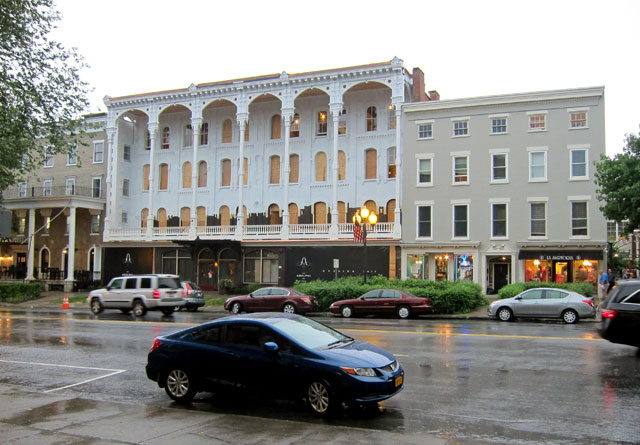
I walked downtown to the main shopping and old hotel area. Sadly the old hotels from the 19th century resort days are gone, but one – The Adelphi Hotel, is being redone. Looking through a doorway – it is all new inside, only the facade was original.

SS-20

I had dinner at a sidewalk table at Wheatfields Restaurant. Nice meal, followed by a downpour and wait before walking “home.”

SS-22

Wednesday – the plan: The National Museum of Racing and Hall of Fame right across from the racetrack; then, Grant’s Cottage, finishing at Chapman Museum in Glens Falls.

I opened the racing museum at 10AM and spent almost two hours there. Pretty good for not really having an interest in horse racing, but the history and cultural aspects of the SS-23sport both in Europe and the US since Colonial times was fascinating. No pictures allowed inside unfortunately. Steeplechase is an early term dating to about 1750 as I recall when horse races were run in Ireland while keeping the church steeple in view. I found the sections of US history during different periods fascinating – a cultural way of life for the upper crust so to speak. Upon leaving I mentioned my frustration at the desk (as I have to do so often) that the history on the placards in all the galleries should be assembled in a booklet so people like me can carry that history and knowledge home. Especially since I could not take images of those placards either.

But now the best of the best – original history from 1885, as it was then, and unchanged, knowledgeable docent, and in-depth history of the times – Grant’s Cottage in Wilton, New York, about 8 miles north of Saratoga Springs atop Mount McGregor.

Grant's Cottage - Mount McGregor

Grant’s Cottage – Mount McGregor

Wow! What I learned about Ulysses S. Grant, our 18th President, and the General who won the Civil War and reunited the nation, making the United States. I bought three books in the gift shop, have read them, thus delaying this post. RAY RECOMMENDS – Visit Grant’s Cottage, not once but often, I am going back.

Grant spent the last 6 weeks of his life, finishing his memoirs here for Mark Twain to publish, and died here. The cottage and its furnishings are essentially unchanged since July 23, 1885. And that lack of change is due to an unusual string of long term caretakers (read, SAVING GRANT COTTAGE by Steve Trimm). Atop a mountain, this cottage was the original hotel, which was moved down from the peak for the building of the 300 room Hotel Balmoral in 1881 by Joseph Drexel from Philadelphia.  In 1884, Grant was diagnosed with throat cancer, and suffered total financial ruin (I will let you discover that fascinating story, much of which is in a book I bought at the museum shop and read, GRANT’S LAST BATTLE by Chris Makowski).

As the summer of 1885 arrived, Grant was encouraged to leave New York City for a healthier environment. Drexel offered his cottage on Mount McGregor, which was accepted. Twain was working with Grant, who was penniless, to finish his memoirs, offering the majority of the profits to Grant so he could provide for his wife. Grant finished his two volume memoirs, dying three days later. Twain paid royalties to Julia Grant of over $450,000 – $11 million today. I could go on and on, I learned so much, but let me just give you a slide show (remember to click on an image to open to larger sizes) and ask you to read and learn more about Grant.

Did I say, visit GRANT’S COTTAGE ???  Then I walked to the top of the mountain, around the fence of the prison that was closed in 2014 to take this view looking east to Vermont.

SS-34

Behind me would be the closed prison’s ball field. In an earlier life this was a veteran’s rehabilitation home, and even earlier a sanitarium. Currently for sale by the State of New York. No, I no longer need a new project, although tempting.

I then headed to Glens Falls to visit the Chapman Museum hoping to learn more of the earlier history of the area, but sadly, that was not the focus of the museum. Don’t take the time to visit. The Hudson River begins in the Adirondack Mountains but becomes larger finally, and makes its last southernly decent in Glens Falls and Hudson Falls. What I was thrilled to discover was the Feeder Canal dug in 1822 from this point to the Champlain Canal which runs from Lake Champlain to the Hudson River. This small canal provides needed water for the Champlain Canal to operate, but also opened up the area for industry in the 19th century. Close to the Champlain Canal is the remains of a fleet of 5 locks rebuilt with sandstone in 1834.

SS-35

By now you know that I am fascinated also with canals, and what they did for the development of industrial and commercial America in the 19th century.

It was then back to the Inn at Saratoga, reading and wine on the porch, dinner, and more reading.

Thursday. Believe it or not, everything is not always perfect for me. The plan today was to get to Rogers’ Island in the Hudson River at Fort Edwards, which I have been trying to experience for almost 20 years – always I was there the wrong day or wrong season. Before leaving I read, from my history book collection, ROGERS RANGERS AND THE FRENCH & INDIAN WAR by Bradford Smith. A Landmark Book (#63) published in 1956. Great reads for juveniles, but also for adults like me who desire an easy overall understanding of a person or event. I finally got a good grasp of the French and Indian War and Robert Rodgers’ exploits. I arrived before the 10 AM museum to see posted: “SORRY, CLOSED TODAY DUE TO A DEATH IN THE FAMILY.”  I wonder how many days or weeks that sign has been up. Remember my visits to THE STUFFED BUN near Townsend, Vermont,  for my “Free Lunch Tomorrow?” Tomorrow never seems to come.

VT-10

Well, I do not get upset – what does that prove? So My next stop over the bridge was to be The Old Fort Museum, also opening at 10. I misread ! On one spot on their website they referred to something at 10AM, but the museum opened at 1PM – too long to wait, so I just wandered the grounds.

I then discovered Lock 7 on the Champlain Canal at the south end of Rogers Island, and had a lovely visit with the lock master. I complimented her on her graciousness, and she said she could enter “public relations time” on her time sheet. Did I tell you I like canals and locks?

Guess what — the plan was to meander back roads home to Rupert, Vermont, Dorset, Manchester, Londonderry, Chester and home. I was maybe five hours ahead of plan, but I was ready to get home, and loved arriving home to “work” and ENJOY.

As I finish this on July 3rd, I feel great, am working on more trips including quite an adventure in the fall (Alex wants to see Mona). So stay tuned to “Shunpiking with Ray” Thank you for reading this far, yours, RAY

Posted in 2016-a SARATOGA SPRINGS, ROADS and ROUTES | Tagged , , , , , , , , | 1 Comment

102 DAYS SINCE YOU HAVE HEARD FROM ME – 26 JUNE 2016 at SAINT-GAUDENS

Yes, way too long since I have been “on the road,” actually been able to be “on the road.” In fact, my travels were limited the end of 2015, and some of you know why – my mobility was restricted. Finally found out I had spinal stenosis pinching nerves making walking hard, if not impossible. I never do things the easy way, so in addition I had a herniated disk on one side and growing cyst on the other. Finally, surgery was scheduled for May 3, but a week before another problem flared up, and I was totally immobile. Then following back surgery ileus set in (you have to look something up), and three days in the hospital turned into 17 days vacation in the hospital and rehab.  But, back surgery (including fusion) was a breeze with no pain, no pain meds, and I am on my way to travel – hopefully.

Alcott-CoverThe last week of February I did get to stay with Alex while David and Mari were in Asia, and I had a great time. We usually walk to school, but he understood, and I drove, but we parked a couple blocks away and walked the rest of the way. I usually cover ground exploring when he is in school, but this time I just went back to their house. I had a project that had been “on the list” for about five years – a booklet on Louisa May Alcott’s time in Walpole from 1855-1857. This year our exhibit at the Walpole Historical Society (I am treasurer) is on Louisa, so it was time to finish that writing project, and I basically did so while Alex was in school. A 40 page booklet, which has been well received so far. Copies $5 plus shipping.

LINCOLN-COVERAnd, 102 days ago I told you about my two nights at (where else?) The Red Lion Inn for my birthday present to myself – 13-15 March. But I am “itchy” to get out. Sadly BLACK BEAUTY and BLUE BELLE each have an illness, and LADY RAB, spits water sometimes, but hey, as a friend said to me this morning, “you love to drive, Ray,” so I gave in and headed out with the “new” grey ghost. If I do not go to Plymouth Notch, where else would you find me?  Yes, at the Saint-Gaudens National Historic Site, in Cornish, NH, and today was the ceremony and unveiling of a new bronze cast of ABRAHAM LINCOLN: THE MAN (Standing Lincoln).

It is a short drive, less than an hour, and I drove up bucolic US 5 on the Vermont side of the Connecticut River. I packed a picnic lunch (sadly only for myself), and sat under a tree looking up to Saint-Gauden’s home.SG-1

Festivities were to begin at 1PM with music by the 12th New Hampshire Regiment Serenade Band.  I put my picnic basket back in the “van” and headed up to the tent set up for the festivities, and shade. It is sad to be alone, but good often because one empty seat is always still available in the first (or second) row. The band was amazing, not only the music, but the history the gentleman on the right gave on Civil War music and bands at war.

SG-2I had to give you 30 plus seconds of what they played – this is the hit of 1855, he said, but of course I cannot remember the tune – tell me what you hear. And, I highly recommend you make the opportunity to hear them and their 1860s music on period instruments.

SG-4

SG-5


The ceremony began with remarks by Park Superintendent, Rick Kendall, followed by NH Governor Maggie Hassan (Tara, she asked me why you were not running again).

Fascinating remarks were given by Thayer Tolles, from the Metropolitan Museum of Art, and a Saint-Gaudens scholar. And then, what a treat to hear Harold Holzer, the noted Lincoln scholar. He related that Lincoln made 4 rare campaign speeches in NH when visiting his son, Todd, at the Exeter Academy. But, those were his last speeches – it was not the custom then to go on the road with campaign speeches. Too bad that tradition did not continue.

Then it was time for the band to lead us up to the unveiling of the statue.

SG-6

Saint-Gaudens received a commission for this statue in 1884 from the Chicago Lincoln Memorial Fund for a sculpture to be placed in Chicago’s Lincoln Park. Finished in 1887, it was this work that brought him to Cornish initially since he was told he could find models with Lincoln’s stature in the area, and he did. Standing Lincoln has become an iconic image of our 16th President, and his son, Robert Todd Lincoln, said it is the best portrait of his father. It was recast and presented to Mexico in 1966 as a good-will gesture.

Work began on this casting in 2009 when the original plaster casts used in 1966 were conserved and repaired. The twenty-one sections once restored were cast in bronze and assembled into the twelve foot statue. A fascinating history brochure was available, and I will cherish my copy. Here is the new cast stature covered by a parachute ready to be unveiled.

SG-7

And, guess who showed up? Mr. Lincoln himself, a member of the Association of Abraham Lincoln Presenters.

SG-8

And, it is time for the unveiling.

SG-9

SG-10

It was a great day to be out, and a wonderful historic event to be part of. Was hard sitting for a couple hours under the tent, but, hey it is supposed to be 6 months to a year for me to be back to “normal” – whatever that is.

I highly recommend visiting the Saint-Gaudens National Historical Site, New Hampshire’s only National Park. I visit three or more times a year. The Sunday concerts at two PM are amazing. Just bring your picnic and wine – remember I was there July 5th last year? Applications for “dates” accepted.

74-22

And, here is the schedule for this summer – you can click on the image to enlarge

SG-11

All I can say is, “RAY RECOMMENDS – VISIT SAINT-GAUDENS in Cornish, NH; and, Calvin Coolidge’s Plymouth Notch, VT.”  Gee, I was at both last year, will history repeat itself?

Posted in Day (or maybe two) Trips, Saint Gaudens, Cornish, New Hampshire | Tagged , , , , , , , , | 6 Comments